
“How to stake crypto safely” is one of the most searched questions in crypto for a reason. Staking is the backbone of Proof-of-Stake networks. You lock coins to help secure the chain and, in return, you earn rewards. Sounds simple. But beginners run into real problems like validator slashing, long lock-ups, confusing dashboards, and fake “staking” websites. One wrong click and your coins are stuck or gone.
This guide is for beginners, casual traders, and long-term holders who want to earn passive rewards without handing their keys to the wrong place. In here you’ll get:
- A plain-English explanation of staking and why it matters
- A safety checklist you can use before staking anything
- A step-by-step flow with real examples
- Common risks and how to avoid them
- A quick glossary for all the weird staking terms
- 20+ FAQs that answer the stuff people actually ask
By the end, you’ll know how to stake with confidence, how to avoid traps, and how to set up a process that protects your portfolio.
Contents
- 1 Why Staking Matters for Beginners
- 2 Staking in Plain Words
- 3 The Safety Checklist
- 4 How to Stake Crypto Safely – Step by Step
- 5 Common Staking Risks and How To Stay Safe
- 6 A Simple Operating Plan You Can Reuse
- 7 Practical Portfolio Tips
- 8 Quick-Reference Glossary: More Crypto Trading Keywords
- 9 FAQs (Frequently Asked Questions)
- 10 A final word, plus a simple plan you can start today
Why Staking Matters for Beginners
Staking is more than “free yield.” It is the way many blockchains stay secure. Your staked coins help validators confirm transactions, keep the network decentralized, and make attacks expensive. You get paid for that service.
A few beginner-friendly reasons staking is worth learning:
- Passive income while you hold – Many major networks offer around 3% to 12% annual rewards, sometimes higher on smaller chains.
- Lower stress – You can ignore minute-to-minute price swings. Rewards keep ticking while you live your life.
- Supports network health – Your stake helps decentralization and resilience.
- Low minimums – Many platforms, including BitZup, let you start small so you can learn the flow first.
Industry trackers in 2025 estimate that well over a hundred billion dollars worth of assets are staked across Proof-of-Stake chains, with Ethereum taking the largest share. That’s not hype. That’s a lot of people choosing to hold and help the network rather than just trade.
Bottom line for beginners: if you already hold PoS coins for the long run, staking them safely often beats leaving them idle.
Staking in Plain Words
Proof-of-Stake is a security system. Instead of miners burning electricity, validators lock up value. If they behave, they earn rewards. If they cheat or go offline, they can be penalized. That penalty is called slashing.
You do not have to run a validator yourself. Most people use one of these paths:
- Exchange or app staking – Click-and-earn inside an app like BitZup. Custodial, very easy.
- Delegated staking – You keep control of your coins in your own wallet and “delegate” vote weight to a validator. Common on Cardano, Cosmos, Polkadot.
- Liquid staking – You stake through a protocol and receive a “receipt” token (like stETH) that you can use elsewhere. Flexible but adds smart contract risk.
- Solo validator – You run your own validator machine. Full control, higher responsibility, not for beginners.
Rewards come from protocol emissions and fees. They are paid in the same coin you staked. APY floats with network conditions and the total amount staked.
The Safety Checklist
Use this list before staking any coin, anywhere:
- Research your coin’s staking rules
- Is there slashing? For what reasons?
- How are rewards calculated?
- Is there a minimum stake?
- Is there slashing? For what reasons?
- Check validator reliability
- Uptime above 99%
- Good commission rate
- Real reputation, not just a flashy name
- Uptime above 99%
- Know the lock-ups
- Is there a bonding period before rewards start?
- How long is unbonding when you unstake?
- Is there a bonding period before rewards start?
- Prefer transparency
- Avoid platforms that hide validator details or can’t explain where the yield comes from
- Look for proof-of-reserves or on-chain visibility when using custodial services
- Avoid platforms that hide validator details or can’t explain where the yield comes from
- Secure your keys first
- Back up your seed phrase on paper or steel, never screenshots
- Use hardware wallets for large balances
- Back up your seed phrase on paper or steel, never screenshots
- Turn on defenses
- 2FA on every account
- Strong and unique passwords with a password manager
- Withdrawal address whitelist where available
- 2FA on every account
- Test with tiny amounts
- Do a small stake and an unstake to learn the timing and fees before going bigger
- Do a small stake and an unstake to learn the timing and fees before going bigger
- Track everything
- Note validator, date, amount, expected APY, and unbonding end date
- Keep tax records from day one
- Note validator, date, amount, expected APY, and unbonding end date
If a staking option fails even one line above, slow down or skip it.
How to Stake Crypto Safely – Step by Step
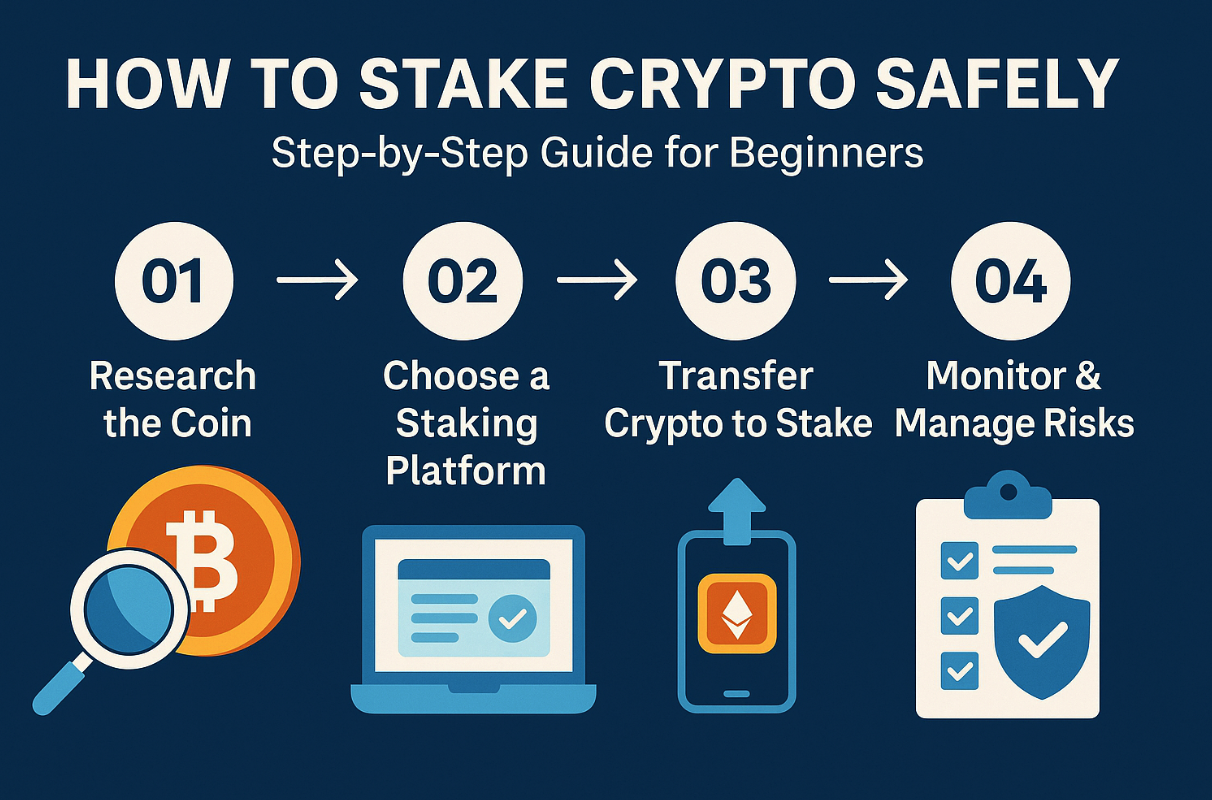
01) Choose the right coin to stake
Not every PoS coin is equally beginner-friendly. Start with projects that have wide documentation, big communities, and stable infrastructure.
- Ethereum (ETH) – The largest PoS network. Solo validators need 32 ETH, but most beginners use pooled or liquid staking. Rewards are moderate and reliable.
- Cardano (ADA) – Easy delegation, no slashing for delegators, simple mobile wallet flows.
- Polkadot (DOT) – Strong governance culture, but unbonding is long at 28 days.
- Cosmos (ATOM) – Delegated staking with clear validator lists and a common wallet ecosystem.
- Solana (SOL) – Fast chain and popular, higher APY sometimes, but you should be mindful of past outages and verify validators carefully.
Beginner tip: if you’re brand new, start with Cardano or an ETH staking pool. They’re well documented and the flows are gentle.
What to avoid at first: brand new chains with very high APY promises, low liquidity, or vague docs. High APY often hides high risk.
02) Pick a staking method that matches your risk and skills
A) Exchange or app staking (custodial)
You click “Stake” inside an app like BitZup, pick your coin, see the APY, and confirm. The app handles validators behind the scenes. It is easiest. The tradeoff is custody risk. If the platform has issues, so do you. Favor platforms with proof-of-reserves, clear security controls, and responsive support.
B) Delegated staking (non-custodial)
You hold coins in your own wallet and delegate to a validator. Your keys stay with you. If the validator misbehaves, you might face slashing depending on the chain’s rules. Pick reliable validators with long uptime.
C) Liquid staking
You deposit coins into a protocol and receive a liquid token back (like stETH for ETH). You still earn staking rewards, and you can sometimes use the liquid token in DeFi. Flexibility is great. Extra smart contract risk is real. Only use well known protocols and never stake your entire stack this way.
D) Cold wallet staking / hardware-assisted
For some chains, you can delegate from a hardware wallet. This is a solid middle path: you keep private keys offline while participating in staking. It is slightly more technical during setup but is a favorite for long-term holders.
Case study to remember: centralized yield platforms that hid risk and lacked transparency imploded in 2022. Many users learned a hard lesson. If someone cannot explain exactly where yield comes from, it is not staking, it is blind trust.
03) Understand lock-ups and unbonding
Every chain has its timing rules.
- Ethereum – Withdrawals are available but can queue. Most users staking via pools see a short processing time, roughly on the order of a day for withdrawals to finalize, depending on network conditions.
- Polkadot – Unbonding is 28 days.
- Cosmos chains – Often 21 days.
- Cardano – Delegation has an epoch delay before rewards start, but funds are not “locked” in the same way.
Golden rule: never stake coins you might need next week. Always keep some liquid for emergencies. If you tie up everything and prices dump, you could be stuck watching without options.
04) Calculate rewards vs risk before you click
Rewards are not magic. They come with tradeoffs.
- Rewards drivers – Network inflation, fees, your validator’s commission, total staked supply, and the time your coins are actually bonded.
- Risks to score – Validator slashing, long unbonding, protocol bugs or governance changes, wrapped token depeg risk in liquid staking, and custody risk if you do it through an exchange.
Simple mental math:
If a coin offers 8% APY but has 21–28 day unbonding and slashing risk, do you accept that for your situation? Some people split across two methods: 60% delegated from a hardware wallet, 40% via a reputable liquid staking protocol for flexibility. You do not have to choose only one way.
Tools that help: staking dashboards to view current network APY, validator explorers to check uptime and commission, and a basic spreadsheet where you plan stake, rewards, and unbond dates. No fancy software needed. Just stay organized.
05) Example walk-through ..staking ETH using a beginner-friendly flow
This is a realistic flow many first-timers follow. Keep amounts small while learning.
- Buy ETH inside an app you already use and trust, like BitZup.
- Move ETH to your wallet if you plan non-custodial staking. MetaMask works for many, and a hardware wallet like Ledger or Trezor is even better for larger balances.
- Choose staking approach:
- If you want easiest possible path, use BitZup’s in-app pooled staking.
- If you want non-custodial with flexibility, consider a widely used liquid staking protocol. You will receive a receipt token like stETH that accrues rewards.
- If you’re advanced, you can run a validator or use a decentralized pool like Rocket Pool minipools.
- If you want easiest possible path, use BitZup’s in-app pooled staking.
- Stake a small test amount first. Watch how the dashboard updates. Locate the reward line. Check the estimated rate.
- Note your exit path. Where is the unstake button? How long is the unstake or withdrawal queue? Is there any fee? Put the date in your notes.
- Scale slowly. If everything works and you feel comfortable, you can add more. Never rush your full stack in one go.
What to watch on ETH: liquid staking token price can slightly deviate from ETH in short periods. This is normal in volatile markets. If you need to exit fast, you may accept a small discount. If you can wait for the protocol withdrawal queue, you can redeem 1 to 1. Plan ahead.
Common Staking Risks and How To Stay Safe
1) Validator slashing
- What it is: a penalty when a validator double signs or goes offline in violation of rules.
- Impact on you: on chains with slashing for delegators, your stake can be reduced.
- How to avoid: pick validators with strong uptime and community reputation, avoid those charging 0% commission forever, and diversify across two or three validators if the chain supports it.
2) Centralization risk
- What it is: putting all stake on a single exchange or the top few validators.
- Impact: one failure hits your whole stack and hurts network health.
- Fix: split stake methods and validators. Keep some in self custody.
3) Lock-up and liquidity risk
- What it is: long unbonding on chains like Polkadot and Cosmos.
- Impact: you cannot exit during drawdowns or urgent needs.
- Fix: never stake 100%. Keep an emergency liquid cushion. Ladder your stake so unbond windows are staggered.
4) Smart contract risk (liquid staking)
- What it is: bugs or oracle failures in the protocol that issues your liquid token.
- Impact: token depegs or funds get stuck.
- Fix: stick to widely audited and widely used protocols. Do not chase new ones for extra APY.
5) Custody risk (centralized platforms)
- What it is: you hand control to a company. If they stop withdrawals, you wait.
- Fix: prefer platforms that show transparent controls, and use non-custodial flows for a large part of your holdings.
6) Phishing and fake sites
- What it is: lookalike websites that steal your seed or trick you to sign malicious transactions.
- Fix: bookmark official pages once. Never click “connect wallet” from random popups. Never share a seed phrase with “support.”
Real-world incident to learn from: there have been periods when fake staking sites targeted Solana users with perfect clones of real dashboards. They pushed wallet connection popups that asked for full permissions. Users approved without reading. Funds moved out instantly. The cure is boring but effective: type addresses manually, use bookmarks, verify app names in your wallet before you sign, and reject anything that asks for unusual permissions. Slow fingers save coins.
A Simple Operating Plan You Can Reuse
This little routine will keep most people safe:
- Before staking – security first: hardware wallet, 2FA, password manager, seed backups in two locations.
- When staking – test with a tiny amount, then scale. Keep 20% liquid.
- After staking – create a table with: coin, validator, date staked, expected APY, unbond start, unbond end, where rewards go.
- Monthly – check validator status, confirm rewards are arriving, skim rewards to wallet if you prefer not to compound, or restake if that is your plan.
- Quarterly – reassess allocation. Any validator fee change? Better option? Convert a slice of rewards to stablecoins if you want to reduce portfolio volatility.
- Yearly – export tax records and a full wallet backup test. Practice restoring a wallet from seed on a spare device with a tiny test amount so you are sure your backups actually work.
This is dull. That is exactly why it works.
Practical Portfolio Tips
- Don’t stake 100% – keep a rainy day fund in native coin for fees and life events.
- Stagger unbonding – if you stake in chunks over time, your exit windows are spread out too.
- Validator diversification – two or three solid validators beat one.
- Avoid APY chasing – an extra 2% is never worth a 100% loss from a shady protocol.
- Have an exit plan – write how you will exit if prices drop 40% while you are bonded. No panic later.
Taxes and record-keeping
Rules vary a lot by country. Some treat staking rewards as income when received, then capital gains when you later sell them. Others differ. Whatever the rule where you live, clean records help:
- Date staked, amount, and value at that time
- Reward amounts and dates
- Date and value when you eventually sell rewards
- Fees paid, gas costs, and validator commissions
Many apps, BitZup included, offer basic exports. Keep your own spreadsheet too. You will thank yourself later.
Not financial or tax advice. Speak to a qualified professional in your country if you are unsure.
Quick-Reference Glossary: More Crypto Trading Keywords
- APY – Annual Percentage Yield. Your estimated yearly return if current conditions hold.
- Bonding – The process of locking coins to activate staking.
- Delegation – You assign your stake to a validator without handing over keys.
- Epoch – A block of time used for reward and validator cycles on some chains.
- Finality – When a transaction is considered permanent.
- Inflation – New coins minted that help fund staking rewards.
- Liquid staking token (LST) – A token you get in return for staking that represents your staked position.
- Rewards compounding – Restaking rewards so your stake grows.
- Slashing – A penalty that burns a slice of a validator’s stake for breaking rules.
- Unbonding – The waiting period to unlock coins after you unstake.
- Uptime – How consistently a validator stays online and signs blocks.
- Validator – A node that secures a PoS chain and earns rewards.
- Commission – The validator’s cut from your staking rewards.
- Custodial – A service holds your keys for you.
- Non-custodial – You hold your own keys.
- Depeg – When a token that should trade near a reference value drifts away from it.
- Whitelist – Pre-approved withdrawal addresses to stop theft.
- Gas – Network fee for transactions and staking actions.
- Governance – On-chain voting to change protocol rules.
- Restake – Using rewards or your stake to secure multiple services or layers, increasing yield and risk.
FAQs (Frequently Asked Questions)
1) What is the minimum to start staking?
Many chains let you stake tiny amounts through pools. For example, ETH solo validators need a large minimum, but pooled staking removes that barrier. Start with whatever amount helps you learn without stress.
2) Are staking rewards guaranteed?
No. APY is an estimate that can change with network conditions, total stake, and fees. Treat it as variable.
3) Can I lose money while staking?
Yes. Price drops can dwarf rewards. There is also slashing on some chains, smart contract risk in liquid staking, and custody risk if you use a centralized platform.
4) Is delegating safer than exchange staking?
Delegation is non-custodial, which many people prefer. It still has validator risk. Exchange staking is easy but adds platform risk. Splitting across both is common.
5) How long do I have to lock my coins?
Depends on the chain. Some have long unbonding like 21–28 days, others not. Always check before staking.
6) What happens if my validator goes offline?
On some networks you may earn less. On networks with slashing, there can be a small penalty. Pick validators with stable uptime and track record.
7) Should I compound rewards?
Compounding usually increases long-term returns, but it costs gas and keeps funds bonded. Some people skim a bit of rewards to stablecoins and restake the rest.
8) Is liquid staking safe for beginners?
It is convenient but adds protocol risk and potential depeg risk for the receipt token. Start with a small amount until you understand how it behaves in volatile markets.
9) Can I stake from a hardware wallet?
Yes on many chains. This is a popular best practice because your keys stay offline while you delegate.
10) Do I pay taxes on staking rewards?
Usually yes, but rules vary. Many places treat rewards as income when received and capital gains when sold. Keep records and talk to a tax pro.
11) Why is my APY different from what the website showed?
APY is dynamic. It changes with network participation, validator performance, and fees. Your start date and compounding pattern also matter.
12) What is restaking and should I do it?
Restaking re-uses your stake or rewards to secure additional services or layers. It can increase yield and also risk. Do not restake blindly.
13) What is a validator commission and why should I care?
It is the fee your validator takes from your rewards. Very low commission can be a marketing tactic. Look for a fair commission with strong uptime and longevity.
14) Can I stake stablecoins?
Stablecoins do not stake on PoS chains in the same way. If someone offers “staking” for stablecoins, it is usually lending or DeFi yield, not protocol staking. Different risks.
15) Why did my liquid staking token trade below the main coin?
During market stress, receipt tokens can trade at a slight discount. You can redeem for full value if you wait through the protocol’s withdrawal process, but it takes time.
16) How do I pick a validator when there are hundreds?
Filter by uptime above 99%, fair commission, number of delegators, community presence, and time active. Avoid new ones with zero history unless you are intentionally supporting decentralization with a small amount.
17) Can I change validators later?
Most chains allow redelegation or unstake and restake. There may be cooldowns. Check chain rules.
18) Should I split my stake?
Yes, splitting across two or three validators and methods reduces single-point failure risk. Many people keep a portion on a reputable app like BitZup for simplicity and the rest delegated from a hardware wallet.
19) What if I need funds during unbonding?
You wait. That is why you never stake all your liquid balance. If you used liquid staking, you might sell the receipt token on a market, possibly at a discount.
20) Is staking the same as yield farming?
No. Staking secures a network. Yield farming is a DeFi activity that pays incentives for providing liquidity or using protocols. Different sources of return and different risks.
21) Do I still earn rewards while unbonding?
Usually no. Once you start unbonding, rewards stop. Another reason to plan exits and ladder stakes.
22) Why do some chains have no slashing for delegators?
Design choice. Some networks only penalize validators directly. Others share penalties with delegators to encourage careful validator selection. Read the chain’s docs.
A final word, plus a simple plan you can start today
If you are holding PoS coins for the long run, staking can be a smart move. The trick is doing it safely. You do not have to become a validator guru. You do not have to chase the highest APY. You only need a process.
Try this today:
- Enable 2FA everywhere and back up your seed properly.
- Pick one coin you already own and read its staking page for 5 minutes.
- Stake a tiny test amount using a method that matches your comfort: app staking in BitZup for ease, or delegated from a hardware wallet for control.
- Write down the unbonding rules and the exact place you will click to exit.
- After a week, check your rewards. If all feels good, add a bit more. If something felt risky, change validators or methods before going bigger.
Steady and boring wins here. That’s the point. Staking is meant to be quiet, reliable, and safe. Earn while you hold, help secure the networks you believe in, and protect your keys like your future depends on it.
👉 Ready to stake safely? Start staking on the BitZup App and compare rewards with other exchanges. Join thousands of beginners already earning safely with BitZup.
–> Follow us on X and Medium for regular updates , More Blogs
Not financial advice. Always follow your local laws and do your own research.