

Stepping into the world of crypto can feel like learning a whole new language. Terms such as ICO, soft cap, gas fees, seed phrase, and margin aren’t just jargon they’re the building blocks of crypto trading for beginners. Without understanding these essentials, it’s easy to feel lost, make costly mistakes, or even fall victim to scams.
This knowledge is crucial for new investors, traders, and anyone exploring the fast-growing blockchain and digital asset sector. Whether you’re curious about DeFi, experimenting with your first stablecoin, or simply trying to set up a secure wallet, knowing the right terms helps you trade with confidence and avoid common pitfalls.
In this guide, we’ll cover the most important crypto trading keywords every beginner should know, from fundraising terms like ICO and soft cap to practical trading concepts such as maker/taker fees, stop loss, and slippage. We’ll also break down wallet security essentials and share practical advice on how to avoid crypto scams. By the end, you’ll have a solid foundation to start building your own beginner crypto strategy.
Contents
Why Are Crypto Trading Keywords Important?
For anyone exploring crypto trading for beginners, learning the language of the industry is the first step toward making smarter decisions. These terms aren’t just academic they directly influence how you manage risk, calculate fees, and protect your funds.
A 2023 Chainalysis report estimated that over $24 billion in crypto was lost to scams and hacks in the past year alone, much of it targeting newcomers who didn’t understand concepts like seed phrases, hot wallets vs. cold wallets, or how to spot rug pulls. The FTC also highlights that the majority of fraud cases in crypto involve misleading terms or fake projects advertised during ICOs.
By mastering key concepts like market vs. limit orders, slippage, KYC, and gas fees, beginners can avoid common pitfalls and trade with greater confidence. Understanding these basics also makes it easier to compare exchanges, build a beginner crypto strategy, and recognize trustworthy platforms like BitZup that focus on transparency and education.
Crypto Trading for Beginners: Building Confidence Step by Step
Crypto trading for beginners starts with learning the right keywords. Terms like ICO, soft cap, margin, maker/taker fees, wallets, and gas fees are essential because they explain how exchanges work, how to manage risk, and how to avoid scams. In this guide, we’ll define the most important crypto trading terms, show why they matter for new investors, and provide simple steps to build a safe beginner crypto strategy.
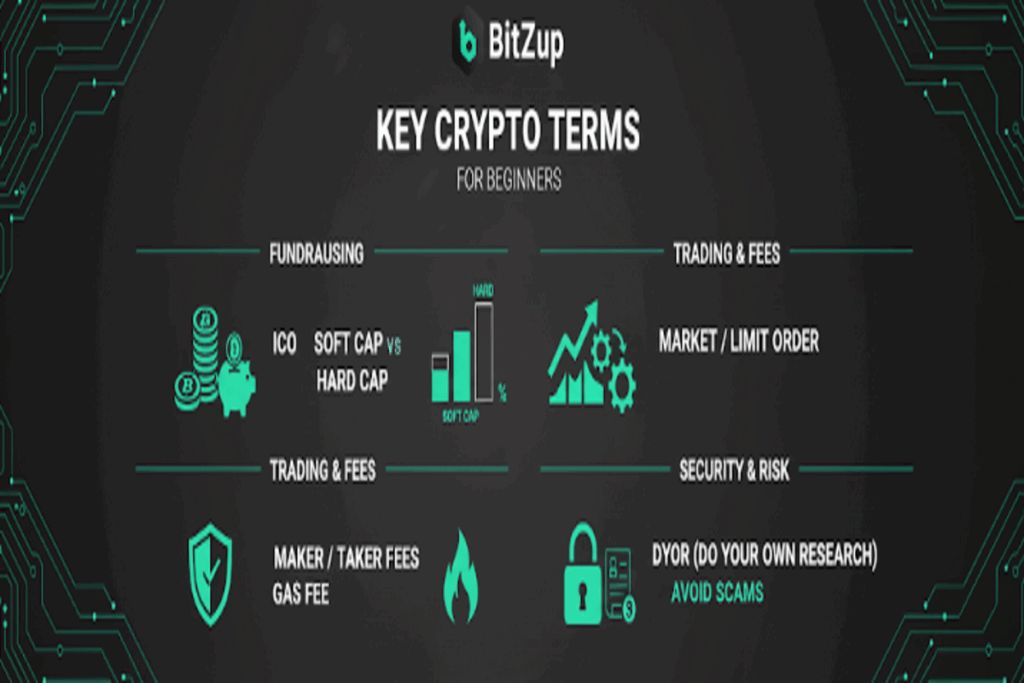
Why Learning the Words Matters: What is Bitcoin?
If you’re new to crypto trading for beginners, the fastest way to get confident is to learn the language. These “buzzwords” are actually practical tools. Understanding ICO, soft cap, market vs. limit orders, maker/taker fees, gas fees, or a seed phrase directly affects your money, your risk tolerance, and your ability to spot opportunities or avoid crypto scams.
Arming yourself with the right vocabulary helps you:
- Place smarter market and limit orders in volatile conditions.
- Estimate total costs (maker/taker + gas fee) before you trade.
- Choose the right wallet (hot vs. cold), secure your private key/seed phrase, and enable 2FA.
- Evaluate new tokens (what’s the ICO, soft cap, liquidity, KYC, and roadmap?).
- Build a beginner crypto strategy you can actually stick to.
Tip: Keep this page bookmarked as a quick glossary while you learn and trade.
What Is an ICO?
An ICO (Initial Coin Offering) is a fundraising event where a project sells a new token usually before it lists on an exchange. It’s similar to an IPO in stocks, but with different rules and risks.
Key points:
- KYC: Many ICOs require identity verification.
- Documentation: Read the whitepaper, tokenomics, and roadmap.
- Risk: High potential upside, high volatility, and scam risk. Always DYOR (Do Your Own Research) and check regulatory advisories.
Suggested reading:
- SEC Investor Alerts on token offerings (learn how regulators view ICO risks).
- FTC guidance on recognizing crypto scams.
What Is a Soft Cap vs. Hard Cap?
When projects raise funds, they publish two targets:
- Soft Cap (Minimum): The least amount needed to proceed (e.g., $1M). If this isn’t met, the project may refund or revise scope.
- Hard Cap (Maximum): The most they will accept (e.g., $10M). Once reached, token sales stop.
Why it matters:
- If the soft cap isn’t met, delivery risk rises.
- A realistic hard cap signals disciplined fundraising and gives early buyers clarity on dilution and liquidity expectations.
Basic Trading Terms: Market, Limit, Slippage, Fees
mastering these reduces mistakes on day one:
Market Order
Executes now at the best available price. Useful for speed. Risk: slippage in thin liquidity.
Limit Order
Sets a specific price you’re willing to buy/sell. Great for controlling entries/exits; may not fill if price never reaches your limit.
Stop Loss
An automated sell order to cap downside in fast volatility. Builds discipline into your beginner crypto strategy.
Slippage
The difference between expected price and executed price common in volatile or low-liquidity markets.
Maker vs. Taker Fees
- Maker fee: When your order adds liquidity (typically a limit order placed away from market).
- Taker fee: When your order removes liquidity (market orders or limit orders that fill immediately).
Exchanges show these as a % of trade value; some reward makers with lower fees to boost liquidity.
Gas Fee
Network fee for on-chain transactions (e.g., Ethereum). Not exchange revenue; it goes to validators/miners.
Wallet & Security Words: Seed Phrase, 2FA, Cold vs. Hot
Private Key / Seed Phrase
- Your private key controls your funds; a seed phrase (12–24 words) is the master backup of that key.
- If someone has your seed phrase, they control your crypto. Never share it. Store offline.
Hot Wallet vs. Cold Wallet
- Hot wallet: Connected to the internet (faster, convenient).
- Cold wallet: Offline hardware or paper (highest security for long-term storage).
2FA (Two-Factor Authentication)
Extra login protection (e.g., authenticator app). Always enable 2FA on your exchange account and email.
Risk & Security: Common Scams + How to Stay Safe
Common threats for beginners:
- Rug Pulls: Project pumps, then founders drain liquidity and vanish.
- Phishing: Fake sites, DMs, or emails mimicking genuine brands.
- Impersonation: Scammers posing as support staff in forums or Telegram.
- Pump-and-Dump: Coordinated hype then mass sell-off.
- Fake Airdrops / Giveaways: Asking for your seed phrase or small “unlock” payments.
Safety checklist:
- Verify domain spelling and SSL (HTTPS).
- Never share seed phrase or codes support will never ask.
- Stick to official exchange apps and channels.
- Start small, set stop losses, and pre-define risk tolerance.
- Prefer limit orders in volatile moments to reduce slippage.
Conclusion: Why Crypto Trading Keywords Matter
Learning the language of crypto isn’t just about memorizing buzzwords it’s about building the foundation for safe, confident trading. From understanding ICO and soft cap, to mastering market orders, fees, wallets, and security terms, every concept in this guide points toward one goal: helping beginners create a smart, secure, and sustainable crypto trading strategy.
The common thread across all these keywords is empowerment. Once you understand them, you can spot scams, manage volatility, and make informed decisions on any exchange. Remember knowledge is your first layer of protection in the fast-moving world of blockchain and digital assets.
Ready to Start Your Crypto Journey?
Understanding the basics is just the first step. The next is putting your knowledge into action on a platform built for beginners and trusted by traders worldwide. With BitZup, you’ll get:
- ✅ Easy account setup with quick KYC
- ✅ Transparent fees and instant buy/sell options
- ✅ Bank-grade security with cold storage & 2FA
- ✅ Access to educational resources via Bitzup Learn.
👉 Sign Up on BitZup Today and start trading smarter, safer, and more confidently. Check us on X and Medium.
Quick-Reference Glossary
- Blockchain: A distributed ledger; the tech behind crypto.
- Stablecoin: A token pegged to stable assets (e.g., USD).
- DeFi: Decentralized finance protocols for lending, swaps, yield, etc.
- Liquidity: How easily you can buy/sell without moving price.
- Volatility: How fast and how far prices move.
- KYC: “Know Your Customer” identity checks on exchanges.
- DYOR: Do Your Own Research foundational for every trade.
- Risk Tolerance: The amount of loss you can accept emotionally and financially.
- Maker/Taker: Fee model related to adding or removing liquidity.
- Gas Fees: Network costs for on-chain transactions.
FAQs
1) What is an ICO in crypto trading?
An ICO is a token sale to raise funds before a token lists on an exchange. Review tokenomics, KYC, and regulatory alerts; always DYOR.
2) What’s the difference between soft cap and hard cap?
Soft cap is the minimum funding to proceed; hard cap is the maximum accepted. Both affect token distribution and liquidity.
3) What is a margin call in crypto?
If you trade on margin, a margin call happens when equity drops below maintenance requirements you must add funds or risk liquidation. Beginners should avoid leverage until experienced.
4) What fees should beginners watch?
Maker/taker trading fees, withdrawal fees, and on-chain gas fees. Review fee schedules and confirm totals before placing orders.
5) What is slippage and how do I reduce it?
Slippage is the difference between expected and executed price. Use limit orders, avoid illiquid pairs, and trade during higher liquidity hours.
6) What is a seed phrase and why is it critical?
It’s your wallet master backup. If lost or exposed, funds are unrecoverable. Store offline; never share it. Consider a cold wallet for long-term storage.
7) What is the safest wallet for beginners?
Start with a reputable hot wallet for small amounts, then move long-term holdings to a hardware (cold) wallet. Enable 2FA everywhere.
8) Is Bitcoin safe for beginners?
Bitcoin is widely adopted but still volatile. Learn basics, start small, secure your accounts, and build a plan with clear risk tolerance.
9) What is a stablecoin and when should I use it?
A stablecoin is pegged (often to USD). Traders use them to reduce volatility, park capital, or move value between exchanges.
10) What are maker and taker fees?
Maker adds liquidity (often cheaper). Taker removes liquidity (often pricier). Fees vary by pair, volume, and your exchange tier.
11) How does KYC work on exchanges?
You submit ID to comply with regulations and reduce fraud. KYC also helps with higher limits and improved account security.
12) What is a gas fee?
A network fee for on-chain transfers (e.g., Ethereum). It changes with network congestion. Plan transfers when gas is lower.
13) Can I trade instantly on my phone?
Yes via market orders in the official exchange app. You can also set recurring buys and use price alerts.
14) How do I avoid scams on crypto forums?
Don’t engage with unsolicited DMs; verify official handles; never share seed phrases; cross-check announcements on official sites.
15) What is a good beginner crypto strategy?
Learn core terms, start with small amounts, use limit orders and stop losses, diversify slowly, and always DYOR.