
What is a stablecoin? Crypto can feel like a rollercoaster, right? Prices go up, prices go down, and for most people that’s a little too wild. Not everyone wants to ride those swings every day. That’s exactly why stablecoins exist. They’re digital coins, just like Bitcoin, but designed to stay steady usually around $1.
Imagine you’re a freelancer getting paid from overseas or a trader who doesn’t want to cash out to a bank account every time the market moves. Stablecoins give you that middle ground: fast, digital money that doesn’t bounce all over the place. It’s one of the reasons they’ve become so important in the crypto and fintech world.
In this post, we’ll look at what is a stablecoin, the different types you’ll come across, how they keep their dollar peg, and the risks worth knowing about. By the end, you’ll see why they matter not just for traders, but for anyone who wants a simple, stable way to use crypto in real life.
Contents
What is a Stablecoin?
If you’ve ever watched crypto prices swing up and down like a rollercoaster, you’ll understand why stablecoins matter. They bring something rare to this space stability. Instead of losing sleep over Bitcoin dropping overnight, users can move their funds into a stablecoin that stays close to $1.
And it’s not just traders who care. Stablecoins have become a lifeline for freelancers getting paid across borders, businesses settling invoices, and DeFi users who need a predictable currency to lend, borrow, or stake. According to CoinGecko (2025), the total stablecoin market is now worth over $140 billion, showing how widely they’re being used across the crypto industry. The IMF has even noted that stablecoins could transform international payments by making them faster and cheaper than traditional banking.
So, whether you’re trading, sending money abroad, or just testing the waters of crypto, stablecoins are worth paying attention to. They’re not just another coin they’re the foundation that makes the rest of the system easier to use.
A Stablecoin is a digital currency ?
A stablecoin is a type of cryptocurrency designed to hold a steady value, usually pegged to $1, making it useful for trading, payments, and reducing volatility in the crypto market.
Types of Stablecoins
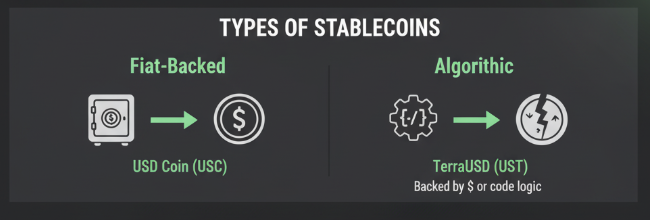
There are two main categories of stablecoins:
- Fiat-Backed Stablecoins: Backed 1:1 by reserves like dollars in a bank account. Example: USDC.
- Algorithmic Stablecoins: Use smart contracts and supply-demand mechanisms to hold their peg. Example: (formerly) TerraUSD (UST).
Some also use collateralized models, where crypto assets like ETH are locked as reserves.
How Do Stablecoins Keep Their Peg?
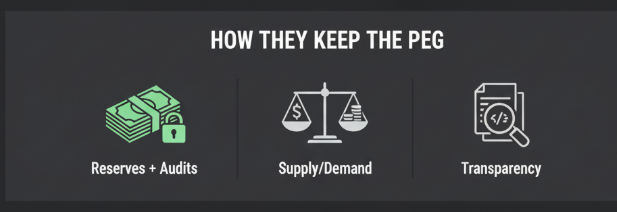
Stablecoins maintain value by ensuring each token can be redeemed for $1 worth of assets. This is done through:
- Reserves & Redemption: Fiat-backed stablecoins hold bank reserves that match their circulation.
- Algorithms: Some use code-based systems to expand or contract supply.
- Transparency & Audits: Many issuers publish attestations or audits to prove they hold enough collateral.
When Stablecoin Pegs Break ?
While most stablecoins aim for stability, history shows deep events can happen:
- Algorithmic failures (e.g., TerraUSD collapse in 2022).
- Liquidity crises during market stress.
- Lack of transparency around reserves.
When a stablecoin loses its peg, users may struggle with redemptions and liquidity.
Why Do Stablecoins Matter?
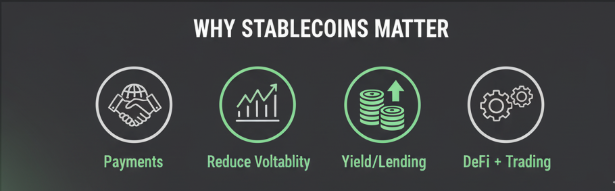
Stablecoins are essential in crypto because they:
- Enable fast, low-cost transactions across borders.
- Allow traders to hedge against volatility without leaving crypto markets.
- Support DeFi applications like lending, staking, and yield farming.
- Act as a settlement layer for exchanges like Bitzup.
In fact, according to CoinGecko (2025), stablecoins account for over $140 billion in circulation, proving their vital role in the digital economy.
Risks and Security to Watch Out For
Despite their name, stablecoins are not risk-free:
- Reserve Transparency: Not all issuers provide reliable audits.
- Regulation: Future rules may impact availability.
- Depeg Risks: Extreme conditions can break the $1 peg.
- Counterparty Risks: Trust in the issuer is crucial for redemption.
Conclusion: The Key Takeaway on Stablecoins
At the end of the day, stablecoins aren’t about hype or speculation—they’re about making crypto practical. Whether it’s trading safely, sending money abroad, or using DeFi apps without worrying about volatility, stablecoins provide the stability that the rest of the crypto world often lacks.
What all of this suggests is simple: stablecoins bridge the gap between traditional finance and digital assets. They combine the speed and borderless nature of crypto with the reliability of everyday money. If you remember one thing, let it be this stablecoins matter because they make crypto usable in real life. How does blockchain work?
Start Using Stablecoins Safely with Bitzup : The Future of Stablecoins
Ready to put stablecoins to work for you? With Bitzup, you can buy, trade, and store trusted stablecoins like USDT and USDC with low fees, instant transfers, and bank-grade security. Whether you’re a beginner or an active trader, Bitzup makes stablecoin trading simple and safe.
Take Control of Your Crypto with Bitzup
Ready to trade safely with stablecoins? With Bitzup, you can buy, hold, and use stablecoins like USDT and USDC with low fees, instant transfers, and secure cold storage. Follow Us on X and Medium for more .
FAQ
1. Are stablecoins always worth $1?
They’re designed to stay around $1, but in extreme conditions, some can temporarily “depeg.”
2. How do stablecoins stay stable?
Most use reserves, collateral, or algorithms to maintain their peg. Fiat-backed coins like USDC hold cash reserves, while algorithmic ones rely on code.
3. Which stablecoins are most popular?
The most widely used are USDT (Tether) and USDC (USD Coin), both supported on Bitzup.
4. Can I buy stablecoins on Bitzup?
Yes. Bitzup lets you buy and trade major stablecoins like USDT and USDC instantly with low fees.
5. Why would I use stablecoins instead of Bitcoin?
Stablecoins reduce volatility, making them useful for payments, savings, or moving funds between trades.
6. Are stablecoins safe for beginners?
Yes, if you choose well-known coins with clear reserve audits and use secure exchanges like Bitzup.
7. How do I transfer stablecoins from Bitzup to my wallet?
Go to your Bitzup wallet, select “Withdraw,” enter your wallet address, confirm with 2FA, and your stablecoins will be sent.
8. What fees does Bitzup charge for stablecoin trading?
Bitzup keeps fees low and transparent. You’ll see exact maker/taker fees before confirming your trade.
9. Does Bitzup keep stablecoins in cold storage?
Yes. Most funds are stored in cold wallets with insurance protection for maximum safety.
10. Can I earn interest on stablecoins with Bitzup?
Bitzup supports staking and earning programs (region-dependent), allowing you to grow your stablecoin balance securely.
11. How long do stablecoin withdrawals take on Bitzup?
Usually 10 – 30 minutes depending on blockchain congestion. Bitzup processes withdrawals instantly on its side.
12. Do I need to complete KYC to use stablecoins on Bitzup?
Yes. Completing KYC verification keeps your account secure and unlocks higher withdrawal limits.
13. What’s the minimum amount of stablecoin I can buy on Bitzup?
You can start with as little as $10 (or local currency equivalent).
14. Are stablecoin profits taxable?
In most countries, yes. Tax treatment depends on your local regulations, so check your country’s crypto tax laws.
15. Why should I choose Bitzup for stablecoins?
Bitzup offers low fees, secure cold storage, fast transactions, and easy access to top stableco
Quick Reference Glossary : More Crypto Keywords
Stablecoin: A cryptocurrency designed to hold a steady value, usually pegged to $1, to reduce volatility.
Peg: The fixed target value (often $1) that a stablecoin tries to maintain.
Reserve: Assets (like cash or bonds) held by stablecoin issuers to back the tokens in circulation.
Redemption: The ability to exchange a stablecoin back into its underlying asset (e.g., $1 in fiat).
USDT (Tether): The largest and most widely used fiat-backed stablecoin.
USDC (USD Coin): A stablecoin issued by Circle, known for publishing regular attestations of reserves.
Algorithmic Stablecoin: A stablecoin that uses smart contracts and supply-demand mechanics to maintain its peg instead of reserves.
Collateral: Assets (fiat or crypto) locked to support the value of stablecoins.
Transparency: Proof (like audits or attestations) that a stablecoin issuer has enough reserves to back tokens.
Depeg: When a stablecoin loses its $1 value due to market stress, lack of liquidity, or reserve issues.
Liquidity: How easily a stablecoin can be bought, sold, or exchanged without affecting its price.
Audit/Attestation: Third-party reports confirming the reserves backing a stablecoin.
Cold Storage: Offline wallets used by exchanges like Bitzup to keep stablecoins safe from hacks.
KYC (Know Your Customer): A verification process required by exchanges to prevent fraud and comply with regulations.
Fiat-Backed Stablecoin: A stablecoin supported 1:1 by traditional money, like dollars or euros, in reserve.