
If you’re new to cryptocurrency, one of the first questions you’ll ask is: what is Bitcoin? Bitcoin is essential to understand because it’s not only the world’s first cryptocurrency but also the foundation of the entire digital asset industry. Whether you’re an individual investor, a fintech enthusiast, or part of the broader financial services sector, knowing the basics of Bitcoin can help you make smarter decisions in the fast-growing crypto space.
What is Bitcoin? In this guide, we’ll provide a simple, beginner-friendly explanation of Bitcoin covering what it is, how it works, and why people trust it as digital money. We’ll also highlight why Bitcoin has value, the risks every beginner should know, and practical tips for getting started safely. By the end, you’ll have a clear understanding of why Bitcoin matters in today’s economy and how you can take your first steps with confidence.
Contents
Why is Bitcoin Important?
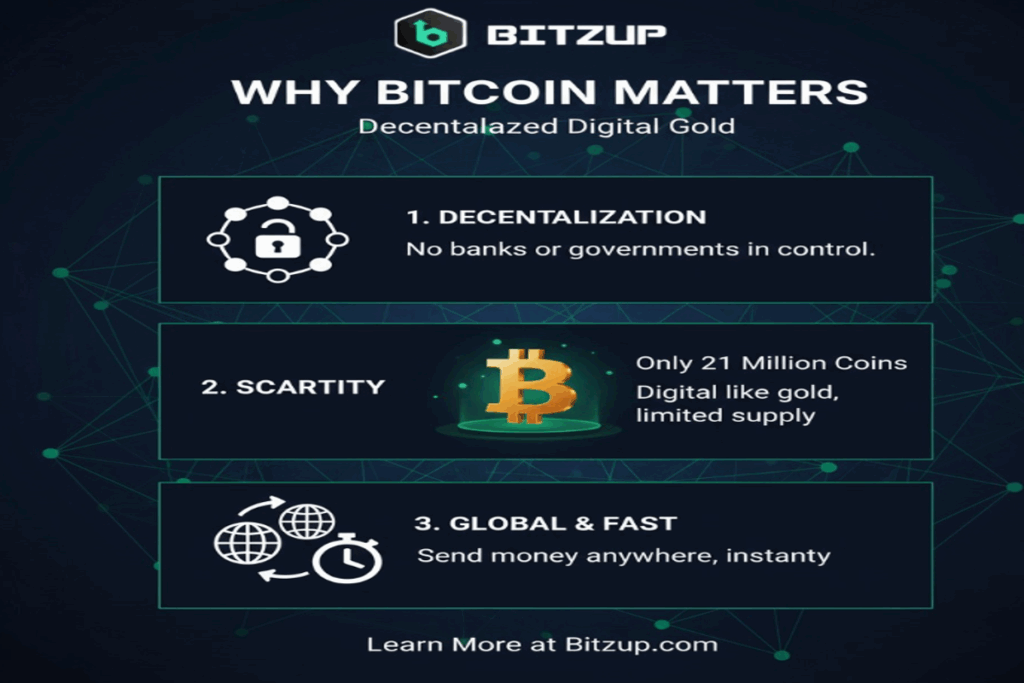
What is Bitcoin and why it matters? Bitcoin matters because it introduced a completely new way to think about money and value. Unlike traditional currencies, Bitcoin is decentralized, meaning no single government or central bank controls it. This gives individuals more freedom and financial independence.
One of the biggest reasons Bitcoin is important is scarcity there will only ever be 21 million Bitcoins in existence. According to CoinMarketCap, more than 19 million Bitcoins are already in circulation (2025 data), making it increasingly rare. This scarcity is what gives Bitcoin its reputation as “digital gold.”
Bitcoin also plays a vital role in the financial technology (fintech) industry. Major institutions, from hedge funds to payment processors like PayPal, have integrated Bitcoin into their services. As the World Economic Forum notes, blockchain and cryptocurrencies are driving a wave of innovation in global finance.
For beginners, understanding why Bitcoin is important means seeing it not just as a digital currency, but as the foundation of an industry worth over $1 trillion globally and growing.
Bitcoin Explained for Beginners: Why It Matters
What is Bitcoin? Bitcoin is the world’s first decentralized digital currency, explained for beginners as money that exists only online and runs on blockchain technology without banks or governments. It allows people to send and receive payments globally through a secure peer-to-peer network, with a fixed supply of 21 million coins that gives it value.
What is Bitcoin?
What is Bitcoin? Bitcoin is the world’s first cryptocurrency, created in 2009 by the mysterious figure Satoshi Nakamoto. Unlike traditional money, it doesn’t rely on banks or governments. Instead, Bitcoin runs on a blockchain a secure, public record that keeps track of every transaction.
In simple terms:
- Bitcoin is digital money you can send to anyone, anywhere.
- It’s powered by a peer-to-peer network instead of banks.
- There will only ever be 21 million Bitcoins in existence, making it scarce like gold.
What is Bitcoin? This scarcity, combined with decentralization, is why many call Bitcoin a store of value or even “digital gold.”
How Does Bitcoin Work? What is Bitcoin?
- Transactions: You send Bitcoin from your wallet to someone else’s Bitcoin address.
- Verification: The network checks transactions through mining computers solving puzzles.
- Blockchain: Verified transactions are added to the blockchain, a permanent digital ledger.
- Security: You control your Bitcoin using a private key/seed phrase. Lose this, and you lose access.
💡 Each transaction needs confirmations to be final, and sometimes you’ll pay fees to speed it up.
Why Do People Use Bitcoin?
- Store of Value: Limited supply (21 million coins) makes it inflation-resistant.
- Fast Payments: Send money across borders in minutes, without banks.
- Decentralization: No single government or company controls it.
- Alternative Asset: Some see Bitcoin as protection against currency volatility.
That’s why what is Bitcoin is important and Bitcoin has value because people trust its blockchain technology and scarcity.
Risks of Bitcoin
Before diving in, beginners should know the risks:
- Volatility: Prices can change fast.
- Security: If you don’t back up your wallet or private key, your Bitcoin is gone forever.
- Scams: Fake apps, phishing, and “get-rich-quick” promises are common.
- Irreversibility: Once sent, transactions can’t be undone.
How to Start Small with Bitcoin
- Learn First: Understand the basics of wallets, exchanges, and blockchain.
- Set Up a Wallet: See How to Set Up a Crypto Wallet.
- Start with Small Amounts: Even $10 can help you learn.
- Buy Safely: Use a secure crypto exchange like Bitzup, with low fees and strong KYC protection.
The Key Takeaway on Bitcoin
What is Bitcoin? At its core, Bitcoin is simple to understand: it’s digital money built on blockchain technology, designed to be scarce, secure, and independent of banks. For beginners, the most important takeaway is that Bitcoin isn’t just a buzzword it’s the foundation of the crypto industry and a tool that empowers individuals to control their own money.
Everything we’ve covered how Bitcoin works, why it has value, the risks involved, and how to get started points to one common idea: Bitcoin represents financial freedom through decentralization.
Start Your Bitcoin Journey with Bitzup 🚀
Ready to put your knowledge into action? With Bitzup, you can buy, sell, and store Bitcoin securely all in one easy-to-use app. Enjoy low fees, fast transactions, and industry-leading safety features like cold storage and 2FA. Check Us on X and Medium.
Quick Reference Glossary : Crypto Trading Keywords
- What is Bitcoin? (BTC): The first cryptocurrency, created in 2009, used for peer-to-peer payments and as a store of value.
- Blockchain: A public, digital ledger that records all Bitcoin transactions securely and transparently.
- Decentralization: A system without a central authority; in Bitcoin, no single government or bank controls the network.
- Peer-to-Peer (P2P): Direct exchange of Bitcoin between users without needing intermediaries like banks.
- Mining: The process of verifying Bitcoin transactions and adding them to the blockchain, rewarded with new coins.
- Halving: An event every four years that reduces mining rewards by half, controlling Bitcoin supply.
- Wallet: A digital or hardware tool that stores your Bitcoin and lets you send/receive transactions.
- Private Key/Seed Phrase: A secret code that gives you control of your Bitcoin. Losing it means losing your funds.
- Address: A unique string of characters where you send or receive Bitcoin. Like a digital bank account number.
- Confirmation: Proof that a Bitcoin transaction has been verified by the network. More confirmations = more security.
- Volatility: Large and sudden price changes, common in Bitcoin and other cryptocurrencies.
- Store of Value: An asset (like gold or Bitcoin) that maintains its worth over time.
- Exchange: A platform (like Bitzup) where you can buy, sell, or trade Bitcoin safely.
- Gas Fee/Transaction Fee: A small payment made to miners for processing Bitcoin transactions.
FAQs
1. Is Bitcoin legal in my country?
In most countries, yes. However, regulations vary. Always check your local crypto laws before investing.
2. Can I lose money in Bitcoin?
Yes. Bitcoin prices are volatile and can move up or down quickly. Invest only what you can afford to lose.
3. Do I need a crypto wallet first to buy Bitcoin?
Not necessarily. If you buy Bitcoin on Bitzup, you get a built-in wallet. For long-term storage, a cold wallet is recommended.
4. Why does Bitcoin have value?
Bitcoin has value because it’s scarce (only 21 million coins will ever exist), decentralized, and trusted by millions worldwide.
5. How many Bitcoins are left to mine?
As of now, over 19 million are mined, with the rest slowly released through Bitcoin halving events until around 2140.
6. Is Bitcoin safe for beginners?
Yes, if you use secure exchanges like Bitzup, enable 2FA, and avoid scams. But remember price volatility is always a risk.
7. How can I buy Bitcoin on Bitzup?
Simply create an account, complete KYC verification, add a payment method, and buy Bitcoin instantly through the Bitzup app or website.
8. What payment methods does Bitzup support for buying Bitcoin?
Bitzup supports debit/credit cards, bank transfers, UPI (in India), and mobile payments like Google Pay/Apple Pay (region dependent).
9. Does Bitzup charge fees for Bitcoin transactions?
Bitzup keeps fees transparent and low. You’ll see exact maker/taker fees before confirming your trade. Check our Bitzup Fees Page.
10. How do I transfer Bitcoin from Bitzup to my own wallet?
Go to your Bitzup wallet, click “Withdraw,” enter your personal wallet address, confirm with 2FA, and your Bitcoin will be sent.
11. How long do Bitcoin withdrawals take on Bitzup?
Typically, 10–60 minutes depending on network congestion. Bitzup processes requests instantly, but blockchain confirmations may take time.
12. Does Bitzup keep Bitcoin in cold storage?
Yes. For maximum safety, Bitzup stores most customer funds in cold wallets with insurance protection.
13. Is my Bitcoin insured on Bitzup?
Bitzup provides insurance coverage on custodial funds stored in cold storage. However, always consider moving long-term holdings to your own wallet.
14. Do I need to complete KYC to buy Bitcoin on Bitzup?
Yes, to comply with regulations and keep accounts safe, you must verify your identity. This also helps unlock higher withdrawal limits.
15. What’s the minimum amount of Bitcoin I can buy on Bitzup?
You don’t need a full Bitcoin. On Bitzup, you can start with as little as $10 (or the local currency equivalent).