
“How to buy Bitcoin securely” is a must-read in 2025. Crypto is mainstream now. The upside is huge access and better tools. The downside is simple too. Scams still exist, fees can bite, and small mistakes can become permanent losses because blockchain transactions are final. If you are just starting, or you tried once and got spooked, this guide is for you.
Here is what you will get. A step-by-step flow to buy on BitZup from zero to first satoshis. A plain comparison of payment methods and fees so you do not overpay. Wallet and withdrawal best practices that put ownership in your hands. Security measures like KYC, 2FA, and address checks that remove avoidable risk. Real examples, small case studies, and exact checklists you can follow today. I will keep the language simple. No hype. No jargon without an explanation. The goal is confidence. After reading this, you can start with tiny amounts, make a safe first purchase, and scale only when you feel ready.
Contents
- 1 Why Buying Bitcoin Securely Matters
- 2 BitZup Safety Checklist Before Buying Bitcoin
- 3 Step-by-Step Guide to Buying Bitcoin on BitZup
- 4 Comparing Payment Methods for Buying Bitcoin
- 5 Understanding Fees and Slippage
- 6 Common Risks and How to Avoid Them
- 7 Advanced Tips for Secure BTC Buying
- 8 A Realistic First Purchase Walkthrough
- 9 Deeper Security for Long Term Holders
- 10 Payment Method Deep Dive
- 11 Slippage and Order Type Basics
- 12 Fee Examples You Can Copy
- 13 Troubleshooting and Support
- 14 Legal and Tax Basics
- 15 Quick Reference Glossary: More Crypto Trading Keywords
- 16 FAQs (Frequently Asked Questions)
- 17 A Simple Strategy You Can Use Today
- 18 Closing Thoughts
Why Buying Bitcoin Securely Matters
Bitcoin transactions are not like bank transfers. There is no “undo” button. If you send to a wrong address, that money is gone. If you click a fake ad and login on a clone page, the thief can drain your account. If you choose an unlicensed platform, withdrawals can freeze at the worst moment. This is not said to scare you. It is said to prepare you. The good news is that secure buying is actually simple if you follow a few rules.
Stats and insights you should know in 2025:
- Chainalysis reported more than two billion dollars lost to crypto scams in 2024. It is less than the peak year, but still a big number. Most losses came from phishing, fake investment schemes, and smart contract exploits.
- Bitcoin is legal or tolerated in most countries. Rules vary by region. What matters on day one is to use a compliant exchange, complete KYC, and follow your local tax rules.
Key benefits of learning to buy safely:
- You protect funds against simple fraud and human error.
- You avoid high or hidden fees that erode small balances.
- You set up a clean workflow for future buys and long term growth.
LSI keywords to keep in mind as you read: BTC safety, avoid crypto scams, secure BTC purchase, safe bitcoin buy, buy BTC with KYC, two factor security, cold wallet storage, address verification, fee calculator, UPI bitcoin, bank transfer BTC
If you take nothing else from this guide, remember this. Slow is smooth. Smooth is fast. Start with test amounts, confirm every step, then scale.
BitZup Safety Checklist Before Buying Bitcoin
Use this checklist every time. It is short on purpose. Print it or save it to notes.
| Step | Action | Why it matters |
| 1 | Verify the exchange | BitZup is licensed, transparent, beginner friendly. You want a platform with a reputation and audited controls. |
| 2 | Enable 2FA | Adds a second factor on login and withdrawals. Stops many account takeovers. |
| 3 | Complete KYC | Needed for compliance, higher limits, and smoother withdrawals. |
| 4 | Check wallet address | Prevents permanent loss from a mistyped or spoofed address. |
| 5 | Start small | A small test buy shows real fees and flow without stress. |
| 6 | Review fees | Know trading, deposit, and withdrawal costs before you click. |
Tip: run a tiny end-to-end test. Deposit a small amount. Buy a few thousand satoshis. Withdraw to your own wallet. Check that it arrived. Only then go bigger.
Step-by-Step Guide to Buying Bitcoin on BitZup
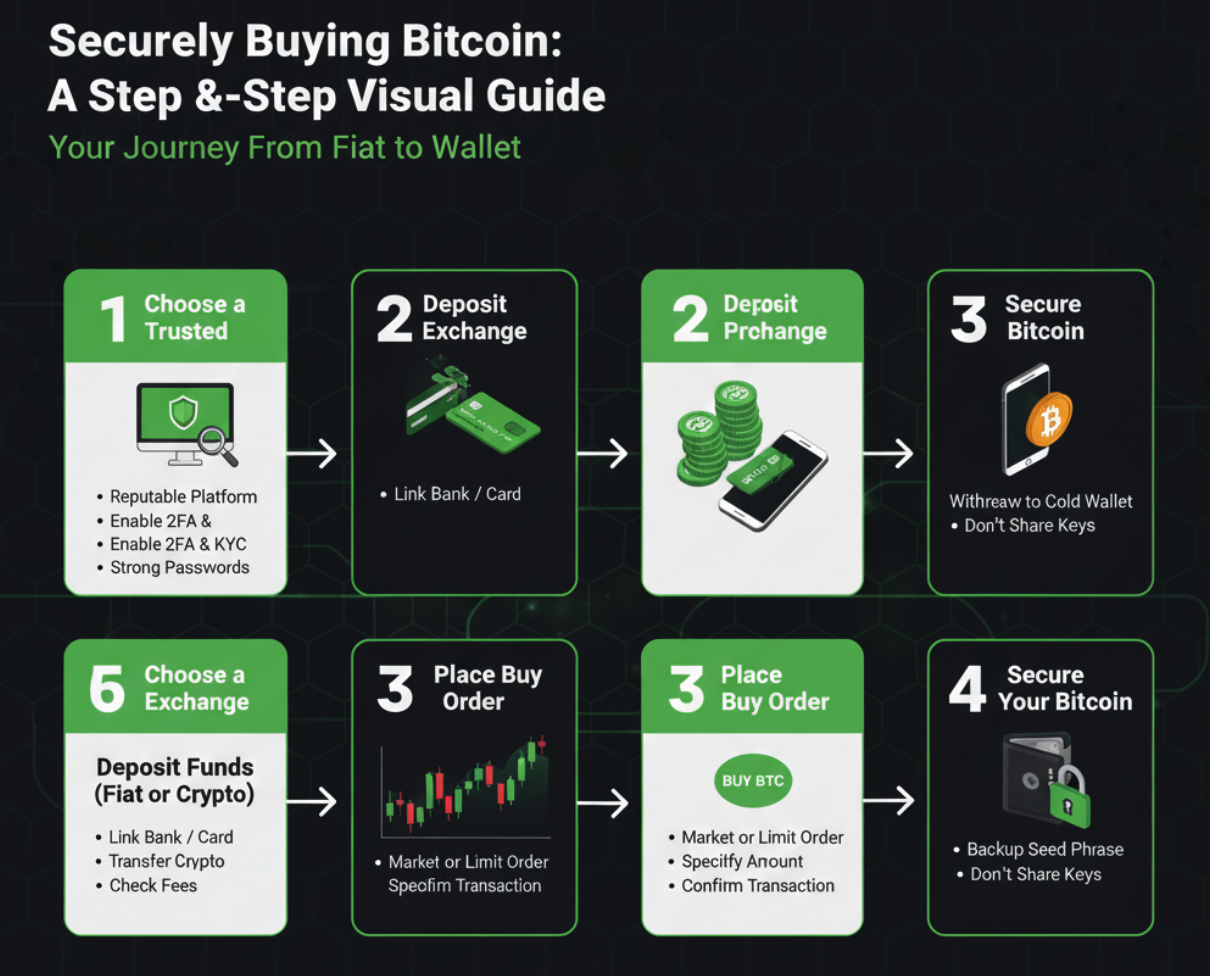
01. Create and verify your BitZup account
- Sign up with email or mobile number. Choose a strong password. Use a password manager if you have one.
- Complete KYC. Upload a valid ID, take a selfie, and add proof of address if asked. Keep scans clear. KYC unlocks higher limits and protects you from account recovery headaches later.
- Activate 2FA. Use an authenticator app like Google Authenticator. SMS is better than nothing, but an app is stronger. Write down your 2FA backup codes and store them offline.
Small habit that helps: create a “Security checklist” note. List email used, 2FA method, backup codes location, and date enabled. You will thank yourself later.
02. Fund your account
Bitzup supports multiple payment methods. Pick what suits your country and your patience. Start small for the first run.
- Bank transfer. Low fees, slightly slower. Great for larger planned purchases. Check cut-off times.
- Credit or debit card. Instant and simple. Fees are higher. Good for small urgent buys. Some banks add an extra conversion fee.
- UPI in India. Instant, secure, and cheap. Popular for both small and medium buys.
Tip: do a small deposit first. Confirm it reflects in your account. Then add more.
03. Place your BTC order
- Go to Buy Bitcoin.
- Enter the amount in your currency or in BTC.
- Review price, fees, and slippage. Slippage is the small difference between expected and executed price. For small orders it is usually tiny.
- Confirm the purchase. You will see a success screen and your new BTC balance in your portfolio.
Beginner path: use a simple market buy for your first time. It fills instantly. Later, if you want more control, you can try limit orders on the trade page.
04. Move Bitcoin to your wallet
Exchanges are good for buying. Wallets are good for holding. That is the clean rule most long term holders follow.
- For short term, a mobile wallet is fine.
- For long term, a hardware wallet is the standard. Popular brands include Ledger and Trezor.
- Always verify the address when you withdraw. Use the copy button. For big amounts, send a tiny test first.
Why move funds: if an exchange gets hacked or freezes, your coins on the exchange are at risk. When you hold your own keys, you control access.
Seed phrase rule: never take a screenshot. Write the 12 or 24 words on paper or metal, store in two safe places, and never share them with anyone.
Comparing Payment Methods for Buying Bitcoin
Different methods shine in different use cases. Here is a quick look you can use to decide.
| Feature | Credit or Debit Card | Bank Transfer | UPI in India |
| Speed | Instant | 1 to 2 hours depending on bank cut-offs | Instant |
| Fees | Usually 2 to 3 percent | 0 to 1 percent | 0 to 1 percent |
| Security | High if you use official app | Very high, direct from bank | High |
| Best for | Small and urgent buys | Larger planned buys with lower fees | Any amount, fast and local |
Small advice: if you plan to DCA weekly, bank transfer or UPI keeps fees low over time. If you caught a dip and want to move now, a card can be fine for a small top-up.
Understanding Fees and Slippage
Here is how costs show up when you buy.
- Trading fee. BitZup’s standard trading fee is 0.1 percent for simple buys. If you trade more over time, your tier can improve.
- Deposit fee. Often 0 percent for bank or UPI. Card processors may add a processing fee.
- Withdrawal fee. Network dependent. Bitcoin fees can move with demand. If fees spike, wait a bit or withdraw during a calm period.
- Slippage. Usually under 0.5 percent for small orders. Big market orders can push price, so break them into chunks or use a limit order if you want exact control.
Tool tip: check the fee summary on the confirm screen. Use the built-in calculator before purchase to compare methods. If you do not see fees clearly, do not buy yet. Ask support or read the fees page, then decide.
Reality check: every platform charges something. You cannot reach zero. What you can do is keep it fair and predictable.
Common Risks and How to Avoid Them
Let us be very practical here. These are the most common ways beginners lose money, plus the fix in one line.
- Wrong address. Check the first and last 4 characters of the address. For big amounts, send a tiny test transaction first.
- Exchange hack or freeze. Do not store long term funds on any exchange. Withdraw to your own wallet after you buy.
- Phishing links. Always use the official BitZup app or a bookmarked domain. Do not click crypto ads in search results.
- Unverified sellers. Avoid peer to peer with strangers if you are new. Use licensed platforms.
- Public Wi-Fi. Avoid buying or logging in over open networks. Use mobile data or a trusted connection.
- Fake support. No support agent will ask for your seed phrase. If anyone asks, it is a scam.
- Typos and rush. Slow down. Check once. Check again.
Case study: Rohit, India.
Rohit wanted to buy 0.05 BTC. He created a BitZup account, finished KYC, enabled 2FA, and deposited a small test via UPI. He bought a tiny amount first, then a larger amount. He verified his Ledger Nano X address twice and withdrew. He paid minimal fees, avoided stress, and got full control. The key was the tiny test run. It gave him confidence and removed hidden surprises.
Advanced Tips for Secure BTC Buying
Once the basics feel easy, these habits make your setup even better.
- Recurring buys. Dollar cost averaging spreads timing risk. You buy a fixed amount on a schedule. You stop overthinking.
- Price alerts. Set alerts in the BitZup app. If price dips to a target, you get a ping. No need to stare at charts.
- Cold storage. For long term holdings, a hardware wallet is standard. Keep a small hot balance for active needs.
- Regular security audits. Once a week, open your security page. Check that 2FA is on, review active sessions, review withdrawal whitelist if supported.
- Email hygiene. Turn on email alerts for logins and withdrawals. If you see anything strange, change password and rotate 2FA.
Two smart extras most people ignore:
- Create a short emergency plan. If your phone dies, how will you access 2FA. Where are your backup codes. Write it once.
- Maintain a tiny wallet playbook. Screenshots of where to click for withdrawal, how to verify address, and where to find the fee page. You will not forget, but having it removes stress.
A Realistic First Purchase Walkthrough
Let us do a demo in words. Imagine you have never bought before.
- Install the BitZup app. Open an account with your email.
- Verify your identity. Upload ID and selfie. Keep the lighting bright.
- Turn on 2FA with an authenticator app. Save backup codes.
- Add ₹1,000 or $20 using UPI or bank transfer. Wait for the balance to show.
- Tap Buy Bitcoin. Enter ₹500. Review price and fees. Confirm.
- You now own a small slice of BTC. You can see it in your portfolio.
- Set up your wallet. If you have a hardware wallet, initialize and back up the seed phrase. If not, use a trusted mobile wallet and write the seed on paper.
- Withdraw a tiny test like ₹200 worth to your wallet. Confirm it arrived.
- Withdraw the rest when you feel good. Or hold a small exchange balance if you plan to buy again soon.
- Write a short note. Date, amount, fees paid, wallet used. This builds your own record. It will help with taxes and with confidence.
That is it. You are now a Bitcoin owner with a clean workflow. Your future self will smile when you repeat this process calmly during the next dip.
Deeper Security for Long Term Holders
If you plan to hold for years, a bit more structure goes a long way.
- Two wallets setup. Keep a small hot wallet for spending or quick moves. Keep a cold wallet for main savings.
- Seed backups in two places. Fireproof or waterproof if possible. Do not store both copies in the same home.
- Label addresses. In your notes, label your main receive address and a backup. You will avoid confusion.
- Use a whitelist. If BitZup supports withdrawal whitelists, add your cold wallet address and lock it.
- Firmware updates. Update hardware wallet firmware a few times per year.
- Test restore once per year. On a spare device or a test wallet, run a dry restore from seed with tiny funds. This confirms your backup works.
This is not overkill. It is the boring good stuff that protects you.
Payment Method Deep Dive
You saw the table. Here are the small details that matter when you choose.
Card buys. Fast and simple. Fees are higher because processors charge the platform. Some banks add a foreign transaction fee. If you only need a small amount or you want a specific entry right away, a card is fine.
Bank transfers. Best for regular scheduled buys. Fees are low. Settlement can take a bit. Most people who DCA weekly prefer bank transfers.
UPI in India. It is fast and cheap. It works well for both small and large buys. The user experience is clean and many beginners like it because it feels familiar.
Common mistake. Buying with a card then withdrawing on a busy day when network fees spike. The total cost ends up higher. Quick fix. If you bought with a card, consider holding for a day or two and withdraw during a calmer fee window. You can check mempool explorers to see current fee recommendations.
Slippage and Order Type Basics
Two quick terms to master.
Slippage is the gap between expected price and filled price. It is small for small orders on liquid pairs like BTC. If you plan to place a large order, consider splitting it or use a limit order so you define the price. The cost of waiting is that a limit order might not fill quickly.
Market orders execute at current best available price. They are fine for beginners and small amounts.
Limit orders execute only at the price you set. More control, less urgency. For your first buys, market is good. Later you can try limits for dips.
Fee Examples You Can Copy
Let us model a simple case so you feel the numbers.
- You deposit ₹10,000 by UPI. Deposit fee is 0.
- You buy BTC. Trading fee at 0.1 percent costs ₹10.
- Slippage is 0.15 percent due to order size. That is ₹15 of price impact.
- You withdraw to a wallet. Network fee that day is around ₹120.
- Total cost is about ₹145 on ₹10,000 or roughly 1.45 percent for a full buy and withdraw run.
If you plan to DCA weekly, you can reduce total fees by withdrawing once per month instead of after every buy. Always leave a small exchange balance only if you are comfortable. Otherwise, safety first.
Troubleshooting and Support
Sometimes stuff happens. Here is how to handle common issues.
- Deposit pending. Check banking cut-offs. Confirm the reference number is correct. Wait one cycle. If still not reflected, contact support with a screenshot and the reference.
- KYC delay. Make sure your photo is clear, ID is valid, and address details match. Resubmit if requested.
- 2FA lost. Use your backup codes to login, then rebind your authenticator. If you lost both phone and backup, expect a stricter recovery flow. That is normal. It protects you.
- Withdrawal stuck. Check the blockchain explorer. If it is not broadcast yet, contact support. If it is on chain, wait for confirmations. Busy networks can slow down.
Polite patience plus clear screenshots gets fast help. Keep it simple and factual.
Legal and Tax Basics
I am not giving legal or tax advice here. Every country is different. Some basics are common.
- Keep a record of buys and sells. Date, amount, fees.
- In many places, buying itself is not taxed. Selling at a profit is a capital gain.
- If you receive rewards or interest, that can be income.
- Export your account statements once per quarter.
- If unsure, talk to a local tax professional early. It saves headaches later.
Good records turn tax season from chaos into copy and paste.
Quick Reference Glossary: More Crypto Trading Keywords
- BTC. Bitcoin.
- KYC. Know Your Customer. Identity checks required by law.
- 2FA. Two factor authentication. Adds a second code to login and withdrawals.
- Slippage. Small price change during order execution.
- Custodial wallet. Wallet where the exchange holds the keys.
- Non-custodial wallet. Wallet you control with your seed phrase.
- Satoshi. The smallest unit of Bitcoin. One BTC is one hundred million sats.
- DCA. Dollar cost averaging. Buying the same amount on a schedule.
- Cold wallet. Hardware wallet stored offline, used for long term.
- Whitelisting. Pre-approved withdrawal addresses for extra safety.
FAQs (Frequently Asked Questions)
- Can I buy Bitcoin with a credit card
Yes. BitZup supports instant card purchases. Fees are higher, so many people use cards for small or urgent buys. - How much BTC can I buy
Your limit depends on your verification level. Complete KYC to unlock higher limits. If you need more, contact support with your use case. - Is it safe to buy Bitcoin on mobile
Yes. Use the official BitZup app, enable 2FA, and avoid public Wi-Fi. Mobile data or a trusted network is better. - Should I move BTC to my own wallet
Yes, if you plan to hold long term. Keep only small amounts on an exchange for active buying. - What fees apply on BitZup
Trading around 0.1 percent, deposit usually 0 for bank or UPI, and withdrawal depends on the Bitcoin network fee at the time. - Can I buy BTC with UPI in India
Yes. UPI is instant and popular. It works well for both small and large buys. - What is slippage
It is the difference between expected and executed price. Small orders on BTC have low slippage. Large market orders can move price more. - Can I buy daily or in installments
Yes. Set up recurring buys to DCA. It removes stress about timing. - Is BitZup legal in India
Bitzup operates with compliance and KYC. Always follow local rules and keep tax records. - Can I buy small amounts like $10 or ₹500
Yes. Bitcoin is divisible. You can start with very small amounts and learn the flow. - Can I cancel a Bitcoin transaction
No. Blockchain transfers are irreversible. That is why address checks and test sends are so important. - How do I know a wallet address is correct
Use the copy button from your wallet, not manual typing. Verify the first and last four characters. For larger amounts, send a tiny test first. - What is a hardware wallet and do I need one
It is a small device that stores your keys offline. You do not need it to start. For long term and larger amounts, it is the gold standard. - What happens if my 2FA phone breaks
Use your backup codes to login and set up 2FA on a new phone. Keep backup codes offline in a safe place. - Why did my withdrawal fee change
Bitcoin network fees change with demand. Withdraw when fees are calm if timing is flexible. - Can I buy Bitcoin for someone else
Yes, but transfer only to a wallet they control. Never hold funds for someone if you do not want the responsibility. - What is DCA and why do people like it
Dollar cost averaging means buying the same amount on a schedule. It lowers timing risk and smooths your entry price. - Is it okay to leave BTC on the exchange for a while
For a short period yes, for long term no. Your own wallet is safer for storage. - What if I sent to the wrong network
Bitcoin has its own network. Do not send BTC to an ETH or BSC address. If you did, contact support immediately. Recovery is rare, so prevention is key. - How fast do I get Bitcoin after buying
Card and UPI buys reflect instantly in your account balance. On-chain withdrawals take a few confirmations to appear in your personal wallet.
A Simple Strategy You Can Use Today
Use this three-day plan to move from zero to first safe buy.
Day 1
- Create BitZup account, set strong password, enable 2FA.
- Complete KYC.
- Read the fees page and note the trading fee and current BTC withdrawal fee.
- Set up a non-custodial wallet. Write the seed phrase on paper. Do not take screenshots.
Day 2
- Deposit a small amount with UPI or bank transfer.
- Buy a tiny amount of BTC.
- Withdraw a micro test to your wallet. Confirm it arrived.
Day 3
- Buy the rest of your planned amount.
- Withdraw to your wallet when network fees look calm.
- Create a short note summarizing amounts, fees, and what you learned.
Repeat weekly or monthly if you plan to DCA. This routine is calm and safe. It works.
Closing Thoughts
Buying Bitcoin securely in 2025 is not complicated. It is a checklist. Trusted exchange, KYC, 2FA, small test transactions, clear fee awareness, and wallet best practices. BitZup brings these elements together in one clean, beginner friendly flow. Your job is to go slowly at first. Test the full path. Confirm every step. Only then scale.
Two final reminders. First, do not rush because of price noise. Bitcoin will have another dip and another rally. Your process matters more than any single day. Second, protect your seed phrase. That one habit is the difference between confidence and constant fear.
Start Small, Buy Bitcoin Securely Today
Create your BitZup account, enable 2FA, and make your first tiny purchase. Use a test deposit, confirm fees, and send a small withdrawal to your own wallet. When you feel confident, scale at your own pace. Your crypto journey is not a sprint. It is a careful sequence. You are in control now.
–> Follow us on X and Medium for regular updates , More Blogs
Not financial advice. Always follow your local laws and do your own research.