
The most crucial element of long-term crypto storage is securing the private keys using robust, offline methods, backed by a strategic redundancy and inheritance plan.
Contents
- 1 Why is Long-Term Crypto Storage Security Paramount?
- 2 5 Pillars of Long-Term Crypto Storage: Best Practice Breakdown
- 2.1 01. The Foundation: Embracing True Cold Storage
- 2.2 02. Redundancy is Not Optional: The Fail-Safe Backup Plan
- 2.3 03. The Ultra-Security Layer: Mastering the Passphrase
- 2.4 04. Multi-Layered Protection for High-Value Assets: Multisig Basics
- 2.5 05. The Human Firewall: Phishing Drills and Software Vigilance
- 3 Storage Choices, Risk Mitigation, and Inheritance Planning
- 4 Quick-Reference Glossary
- 5 FAQs (Frequently Asked Questions)
- 6 Conclusion: Securing Your Digital Legacy
Introduction
The shift toward long-term crypto storage…often referred to as “HODLing”…moves the investor from the fast-paced world of trading to the static, high-stakes environment of self-custody. Unlike bank accounts, digital assets grant the holder absolute control but demand absolute responsibility.
The necessity of adopting rigorous crypto security tips cannot be overstated: the crypto industry has seen billions lost not just to hacks, but to simple mistakes like misplaced seed phrases or outdated security practices. This vulnerability applies to everyone holding non-custodial assets, whether you own $1,000 or $100,000,000 in Bitcoin, Ethereum, or any other token. In this comprehensive guide, we’ll detail the three essential pillars of long-term crypto storage: choosing the right cold storage solutions, establishing an ironclad backup plan and recovery system, and implementing advanced defense layers like the passphrase and multisig basics.
Why is Long-Term Crypto Storage Security Paramount?
The Irreversible Nature of Crypto Theft
The primary reason long-term crypto storage demands perfection is the irreversible and final nature of blockchain transactions. Once an attacker gains access to your private keys or seed phrase, they can drain your wallet in seconds, and there are virtually no legal or technical mechanisms for fund recovery…crypto transactions are final. This means your personal security practice is the only firewall protecting your life savings.
The FBI’s Internet Crime Complaint Center (IC3) frequently reports massive losses from centralized platforms (exchange hacks) and individual wallets (phishing/malware), demonstrating that the threats are constant and evolving. Statistically, the cost of lax security is devastating: a recent study found that nearly 4 million Bitcoin (roughly 20% of the circulating supply) have been permanently lost or are currently held in wallets where the keys have been lost or compromised. This reality makes investing in top-tier crypto security tips and hardware wallet technology a non-negotiable insurance policy.
5 Pillars of Long-Term Crypto Storage: Best Practice Breakdown
01. The Foundation: Embracing True Cold Storage
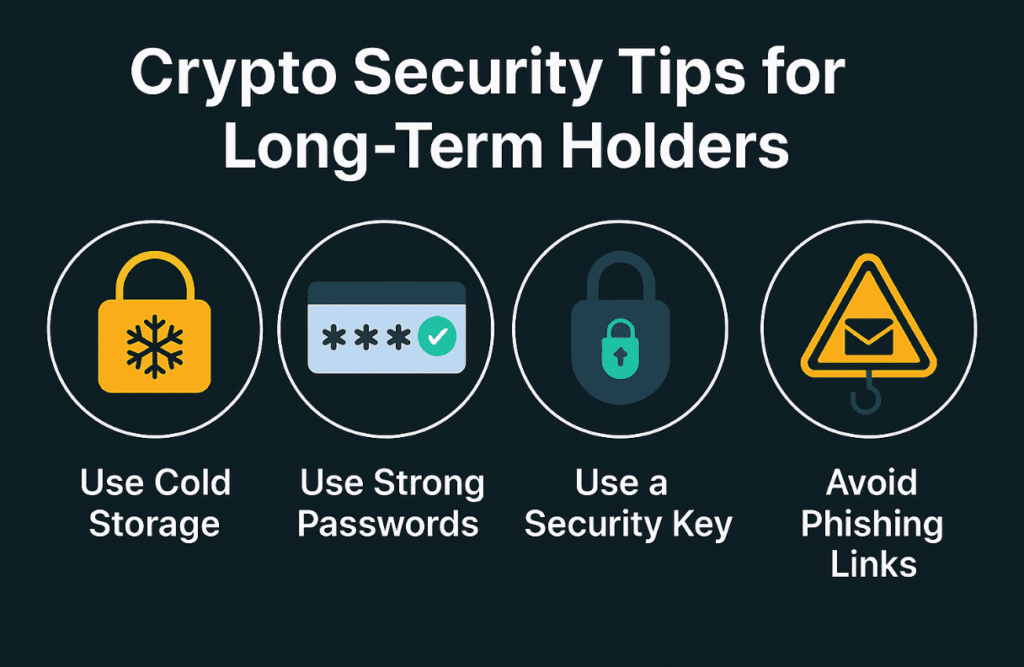
The cornerstone of any long-term crypto storage strategy is the use of cold storage. This means storing the private keys offline, physically disconnected from any internet-enabled device.
Actionable Insight: Hardware Wallet Selection (The Essential Tool)
A hardware wallet is a dedicated, specialized computer designed for one purpose: generating and securing your seed phrase and signing transactions. The best models ensure your private keys never leave the secure element (chip), even when connected to a malware-infected computer. Look for devices from reputable vendors (e.g., Ledger, Trezor) that feature physical screen verification for every transaction and open-source or fully audited security architecture.
02. Redundancy is Not Optional: The Fail-Safe Backup Plan
Your backup plan must account for two main risks: physical loss/destruction of the hardware wallet and the loss/compromise of the seed phrase backup itself.
The Redundancy Rule: Never store the primary seed phrase backup (written on paper or metal) in a single location. Best practices suggest dividing the backup into at least two or three geographically separate, secure locations (e.g., home safe, bank safe deposit box, relative’s secure storage).
Case Study: The Single-Point-of-Failure Disaster
In 2014, a prominent Bitcoin user lost a significant amount of BTC when his physical seed phrase backup, stored only in a home safe, was destroyed in a house fire. The subsequent adoption of fireproof metal backups and multi-location storage became a critical lesson learned by the entire community, directly informing current advice on redundancy and material choice.
03. The Ultra-Security Layer: Mastering the Passphrase
The optional passphrase (often called the 25th word or hidden wallet) is one of the most powerful yet underutilized crypto security tips.
What it is and How to Use it: The passphrase is an additional, user-defined word or phrase that, when combined with the 12 or 24 words of your seed phrase, creates a completely new, mathematically unique wallet. If an attacker discovers your 12-word seed, they still cannot access your funds without the passphrase.
Actionable Strategy: Plausible Deniability
Use a small amount of “bait crypto” on the wallet generated by the 12-word seed without the passphrase. Store the bulk of your assets on the hidden wallet protected by the passphrase. If you are ever coerced into revealing your seed phrase, you reveal only the main seed, preserving the funds in the hidden wallet (plausible deniability). Crucially, the passphrase must be long, memorable only to you, and never stored digitally or next to the main seed.
04. Multi-Layered Protection for High-Value Assets: Multisig Basics
For institutional investors or individuals holding very high values, multisig basics (Multi-Signature) wallets offer an unparalleled level of crypto security.
How Multisig Works: A traditional wallet requires only one signature (one private key) to authorize a transaction. A multisig wallet requires multiple separate, distinct private keys to authorize a transaction (e.g., 2 out of 3, 3 out of 5).
Actionable Use Case: Eliminating Single-Point-of-Failure
By distributing the required keys across different devices or even different geographic custodians, you eliminate the single point of failure inherent in a standard hardware wallet. For example, a 2-of-3 setup could involve: Key 1 (Primary Hardware Wallet), Key 2 (Secondary Hardware Wallet at a different location), and Key 3 (A trusted family member or dedicated storage vault). This makes simultaneous compromise virtually impossible.
05. The Human Firewall: Phishing Drills and Software Vigilance
The most frequent point of failure is not the tech, but the user. Your personal habits are the most critical component of crypto security tips.
Software Vigilance and Firmware Updates:
Always ensure your hardware wallet firmware is up-to-date. Firmware updates often contain critical security patches. NEVER install firmware updates via a link or file; only use the official manufacturer’s application/suite.
Phishing Drills: Treat every unsolicited contact…email, DM, or text…as a potential threat. No exchange, wallet vendor, or Bitzup support agent will ever ask you for your seed phrase. Practice mentally running a phishing drill: “What are they asking for?” If the answer is any secret, the answer is “scam.” Use unique, strong passwords and 2FA (Authenticator App, not SMS) on every crypto-related account.
Storage Choices, Risk Mitigation, and Inheritance Planning
06. Assessing Risk: Should I Split Funds?
For long-term crypto storage, splitting funds is a fundamental risk mitigation strategy. It prevents a catastrophic loss from a single vulnerability.
Actionable Insight: 80/20 Rule:
A common strategy is the 80/20 split:
- 80%: High-value assets stored in the most secure method (cold storage / hardware wallet, protected by a passphrase).
- 20%: Lower value or frequently traded assets kept in a cold storage wallet without the passphrase, or in a vetted, secure exchange account like Bitzup, protected by strong 2FA.
This strategy ensures that the inevitable compromise (human error, clicking a bad link) only affects the smaller, expendable portion, while the core wealth remains safe.
07. Creating a Digital Inheritance Plan
Inheritance is the final, often overlooked, step in long-term crypto storage. If you pass away or become incapacitated, how will your beneficiaries access your assets without compromising the security of your private keys?
The Solution: Legal and Technical Redundancy
A full backup plan must include an explicit Digital Inheritance plan. This involves:
- Legal: Documenting the location of the encrypted or segmented keys/phrases in a notarized will or trust.
- Technical: Using a multisig setup where one key is granted to a trusted executor upon presentation of the death certificate, or utilizing a service that holds encrypted fragments of the passphrase or seed, released only under defined legal conditions. Never include the actual seed phrase in the will itself.
08. Continuous Vigilance: How Often to Update Firmware?
Your hardware wallet is a dedicated computer, and like any computer, it requires maintenance. Firmware updates are vital for patching newly discovered vulnerabilities.
Actionable Routine: Do not make updating a daily chore, but schedule a check for firmware updates every 3-6 months, or immediately before any major transaction. Crucially, always verify the authenticity of the update directly through the official wallet application on a trusted, clean device. The passphrase feature is often the first to be targeted by malicious updates, so vigilance is paramount.
Quick-Reference Glossary
| Term | Definition |
| Cold Storage | Storing private keys completely offline, typically using a hardware wallet, for maximum security. |
| Hardware Wallet | A physical electronic device built specifically to store private keys securely and sign transactions offline. |
| Seed Phrase | A sequence of 12-24 words that serves as the master key to restore access to a crypto wallet and all its funds. |
| Passphrase | An optional 13th/25th word known only to the user, creating a “hidden wallet” for added security and plausible deniability. |
| Multisig (Multi-Signature) | A type of wallet that requires more than one private key (signature) to authorize a transaction. |
| Redundancy | The practice of creating multiple, separate, and geographically diverse backups of the seed phrase to prevent total loss. |
| Phishing Drills | The mental practice of identifying and resisting social engineering attempts (like fake support messages) designed to trick a user into revealing secrets. |
| Firmware Updates | Software updates for a hardware wallet device, often containing critical security patches and new features. |
FAQs (Frequently Asked Questions)
- Q: Should I split my crypto funds across multiple hardware wallets?
A: Yes, splitting funds across multiple hardware wallets is a highly recommended crypto security tip for long-term crypto storage. It limits potential losses if one device or its seed phrase is compromised (the 80/20 rule). - Q: How often should I perform firmware updates on my hardware wallet?
A: You should check for firmware updates every 3-6 months. Crucially, only update using the official manufacturer’s application on a trusted device, and never click links or download files from external sources. - Q: Can I use a metal plate to store my seed phrase, or is paper better?
A: A metal plate is better for long-term crypto storage because it provides redundancy against physical threats like fire, water, and corrosion, which paper backups cannot withstand. - Q: What is a passphrase and how does it make my hardware wallet more secure?
A: The passphrase is an extra, user-defined word that creates a unique, hidden wallet, making your funds inaccessible even if an attacker gets your 12-word seed phrase. It offers plausible deniability. - Q: Is it safe to store my seed phrase backup in a bank safe deposit box?
A: Yes, a bank safe deposit box is an excellent option for long-term crypto storage as it provides geographical separation and protection against home-related disasters (fire, theft). - Q: How do multisig wallets eliminate the single point of failure in my security setup?
A: Multisig basics require multiple distinct keys (e.g., 2 out of 3) to sign a transaction, meaning no single compromised device, lost seed phrase, or single person can move the funds. - Q: Should I use my main computer to set up my hardware wallet?
A: Ideally, no. Use a freshly wiped, air-gapped device (a computer never connected to the internet) or a dedicated, freshly scanned device to perform the initial seed phrase generation to prevent malware logging your inputs. - Q: What is a “phishing drill” and how can it help my crypto security?
A: A phishing drill is the mental practice of treating every unsolicited message as an attack, helping you recognize the social engineering tactics (like urgency or impersonation) used to steal your seed phrase. - Q: If I lose my hardware wallet, are my crypto funds gone forever?
A: No, your funds are safe as long as you have securely backed up your seed phrase and can restore it onto a new hardware wallet or software wallet. Losing the device is only a logistical issue. - Q: Should I keep my crypto security tips backup plan hidden from my family?
A: While keeping the details secret from everyone is key for immediate security, you must implement an inheritance plan so trusted family members can access funds after your passing, often involving legal documents and segmented key dispersal. - Q: Is it safer to keep my crypto on an exchange like Bitzup or use cold storage?
A: For long-term crypto storage (HODLing), cold storage (using a hardware wallet) is safer because it removes counterparty risk and exchange hack vulnerability. Exchanges are best for actively trading funds. - Q: What is the most common mistake people make with their seed phrase backup?
A: The most common mistake is storing the seed phrase digitally (on a phone, cloud storage, or password manager), which makes it immediately vulnerable to remote hackers and malware. - Q: How does using a passphrase provide me with “plausible deniability”?
A: If forced to reveal your seed phrase, you reveal only the main seed (which holds a small “bait” balance), allowing you to deny knowledge of the hidden wallet secured by the secret passphrase. - Q: Are software wallets considered hot storage or cold storage?
A: Software wallets (on mobile or desktop) are considered hot storage because the private keys are created and used on an internet-connected device, making them vulnerable to network attacks. - Q: What should I use to back up my seed phrase for maximum longevity?
A: Use specialized titanium or stainless steel plates and stamp or engrave the words. This material provides maximum redundancy and resistance against fire, flood, and decay. - Q: How often should I check my cold storage wallet to ensure my funds are still there?
A: While you don’t need to check daily, testing your hardware wallet setup every 6-12 months is a good crypto security tip to ensure your firmware updates are done, the device works, and the seed phrase is correctly backed up. - Q: If I forget my passphrase, are my funds lost forever?
A: Yes. If you forget the passphrase, there is no recovery method; it is not backed up by your main seed phrase. This is why the passphrase must be memorable only to you but never written down with the main seed. - Q: How can I safely transfer my long-term crypto from an exchange to my hardware wallet?
A: Perform a small test transaction first. Send a minimal amount of crypto to your hardware wallet address, verify receipt, and only then send the large remainder to ensure the address and network are correct. - Q: Is using two-factor authentication (2FA) enough for my crypto security?
A: 2FA is essential for exchange accounts (hot storage) but irrelevant for cold storage. It is a necessary but insufficient crypto security tip; your hardware wallet and seed phrase storage are your primary defenses. - Q: Should I use a dedicated, anonymous email for all my crypto exchange accounts? A: Yes, using a separate, unique email address for all crypto activity helps prevent general email breaches (which might leak other login data) from compromising your specialized crypto security tips and accounts.
Conclusion: Securing Your Digital Legacy
Mastering crypto security tips is an ongoing practice, not a one-time event. For long-term crypto storage, the future belongs to those who prioritize redundancy, decentralization of risk, and continuous vigilance. The core lesson is that digital safety depends on physical separation: the hardware wallet provides the essential cold storage, the passphrase provides the deniability, and the multisig basics and backup plan provide the final layer of redundancy against both theft and disaster. By adopting these layered, actionable steps, you are not just securing your investments; you are protecting your digital legacy for decades to come.
Secure Your Journey
Crypto Security Checklist!
Ready to transition from a vulnerable holder to a digital asset security master? Check our Crypto Security Checklist to audit your current long-term crypto storage setup and ensure every key, every backup, and every account is fully secured.
👉 Ready to stake safely? Start staking on the BitZup App and compare rewards with other exchanges. Join thousands of beginners already earning safely with BitZup.
–> Follow us on X and Medium for regular updates , More Blogs
Not financial advice. Always follow your local laws and do your own research.