
Contents
- 1 Introduction
- 2 Why Chart Reading is Your Essential Trading Skill
- 3 Candlesticks 101: Decoding the Price Story
- 4 01. Candlestick Meaning: Open, High, Low, Close
- 5 02. The Timeframe: Zooming In and Out
- 6 Trendlines and Volume: The Conviction Behind the Move
- 7 03. Reading the Trendline: The Direction of the Market
- 8 04. Volume: The Fuel Behind the Price
- 9 Common Mistakes and Simple Tools
- 10 05. Support and Resistance Simple: Finding Price Boundaries
- 11 06. Avoiding Common Beginner Mistakes
- 12 Quick-Reference Glossary
- 13 FAQs (Frequently Asked Questions)
- 14 Conclusion: Trading with Information, Not Emotion
- 15 What is a Crypto Wallet?
Introduction
To a beginner, a cryptocurrency price chart looks like a confusing wall of colored bars and lines. Yet, this visual data is the universal language of the market. Learning how to read crypto chart data is essential because it strips away emotional noise and provides objective information on supply and demand.
This knowledge applies to anyone engaging in digital assets, from passive investors checking Bitcoin’s long-term trend to active traders moving Solana on an exchange like Bitzup. In the financial world, those who can read the chart have a massive advantage over those who trade based on news or feelings. This guide will simplify the crypto chart basics by detailing the meaning of candlesticks, explaining volume, establishing key trendline analysis, and revealing the simple power of support and resistance simple zones.
Why Chart Reading is Your Essential Trading Skill
Understanding crypto chart basics is paramount because the chart is a real-time record of all market participants’ actions, fears, and hopes. It’s the only objective tool you have. As famed trader Jesse Livermore noted, “The game of speculation is the most uniformly fascinating game in the world. But it is not a game for the stupid, the mentally lazy, the man of inferior emotional balance, or the get-rich-quick adventurer.” The chart trains you out of being the last two.
The Statistic: Studies show that retail traders who use technical analysis, even basic forms like support and resistance simple drawing, tend to have better risk management practices (e.g., placing stop loss orders) than those who rely solely on gut instinct or social media hype. The chart provides the data necessary to implement the beginner crypto trading strategy learned in our previous guides, moving trading from guesswork to calculated probability.
Candlesticks 101: Decoding the Price Story
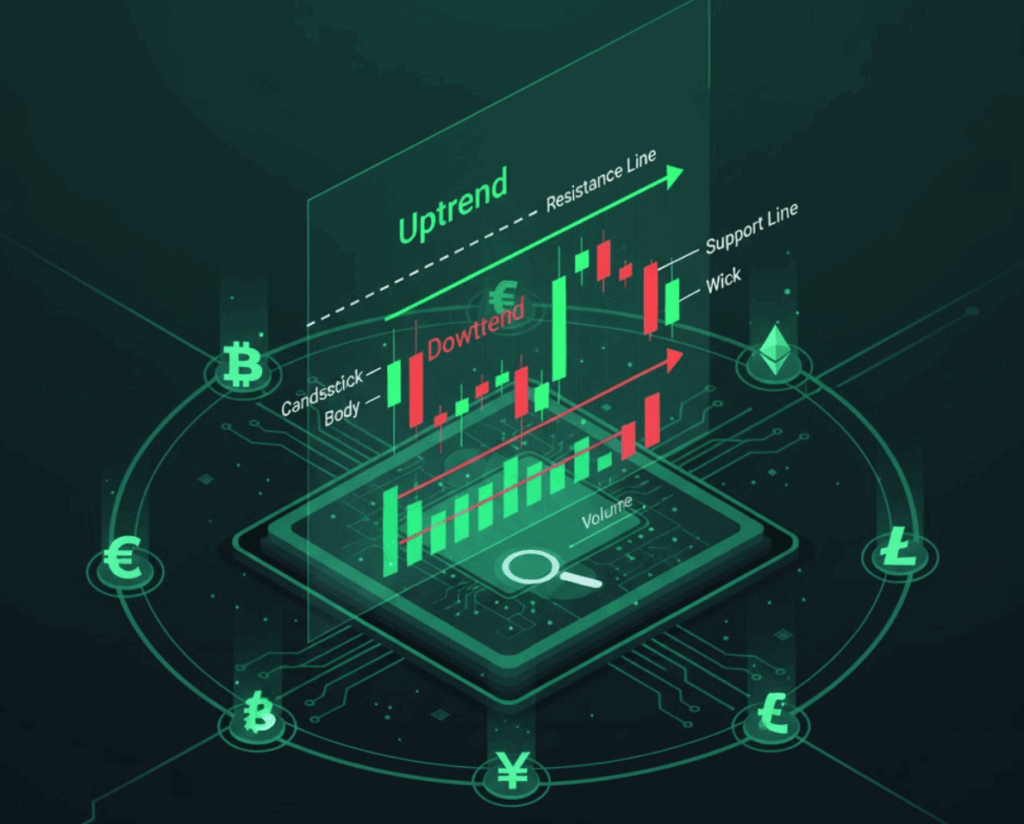
Every price chart you see…whether tracking solana price or BTC…is built from individual candlesticks. Each one tells a complete story about price movement during a specific period.

01. Candlestick Meaning: Open, High, Low, Close
The candlestick meaning is derived from its two main parts: the body and the wicks.
- The Body: This is the fat, rectangular part. It represents the range between the open price (the price when the period started) and the close price (the price when the period ended).
- Green/Hollow Candlestick (Bullish): The price closed higher than it opened. Buyers were in control.
- Red/Solid Candlestick (Bearish): The price closed lower than it opened. Sellers were in control.
- The Wicks (Shadows): These are the thin vertical lines extending from the top and bottom of the body. They represent the absolute highest (high) and lowest (low) prices reached during that timeframe, showing where the price was rejected.
Actionable Insight: A small body with long wicks indicates high volatility but indecision…buyers and sellers fought hard, but the price didn’t move far from the open. A long body with small wicks indicates strong conviction and follow-through by one side.
02. The Timeframe: Zooming In and Out
The timeframe is the duration each candlestick represents. Before you can truly grasp how to read crypto chart data, you must choose your timeframe.
- Short Timeframes (1-minute, 5-minute): Used by day traders and scalpers for rapid entry/exit. Shows highly detailed, but often noisy, price movements.
- Long Timeframes (4-hour, Daily, Weekly): Used by position traders and long-term holders. Shows major trends and reliable support and resistance simple zones by filtering out market noise.
Actionable Tip: Beginners should focus primarily on the Daily and 4-hour timeframe. These timeframes give you a reliable perspective of the major trendline without overwhelming you with the rapid fluctuations seen in 5-minute charts.
Trendlines and Volume: The Conviction Behind the Move
03. Reading the Trendline: The Direction of the Market
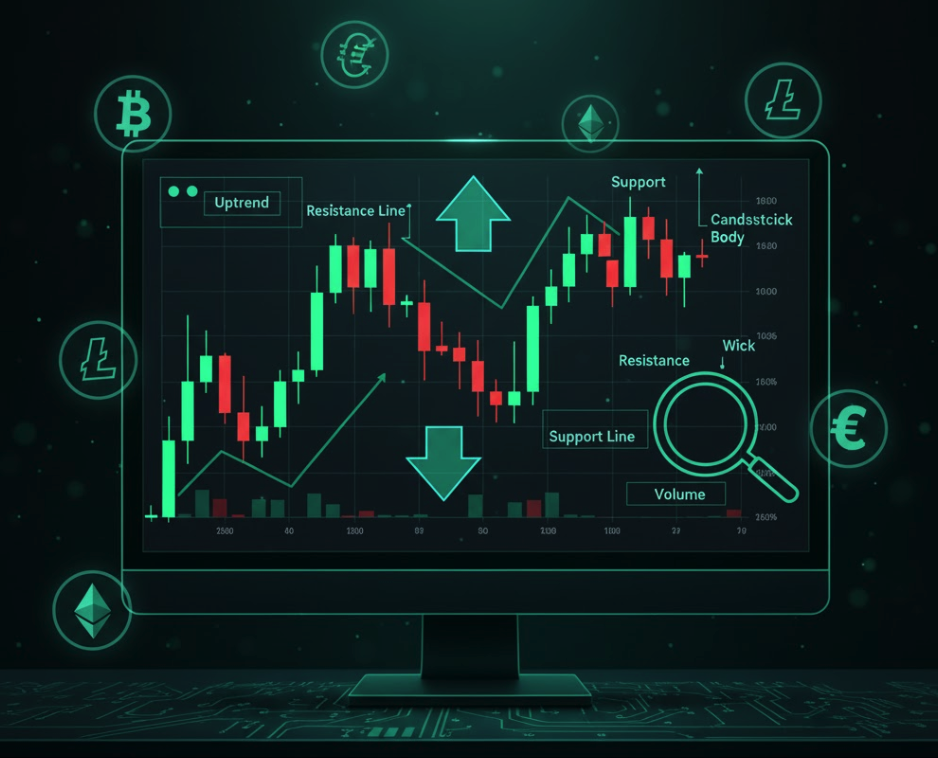
A trendline is a simple line drawn on the chart connecting either the rising lows (for an uptrend) or the falling highs (for a downtrend). It tells you the market’s current direction.
- Uptrend: Characterized by higher highs and higher lows. The price is supported by the rising trendline.
- Downtrend: Characterized by lower lows and lower highs. The price is capped by the falling trendline.
Actionable Insight: Trading the Breakout: A key event is when the price breaks decisively below an established uptrend line or above a downtrend line. This often signals a reversal and is a primary trigger for setting a stop loss or planning a new entry.
04. Volume: The Fuel Behind the Price
Volume is the total number of assets traded during a specific timeframe and is usually represented by bars at the bottom of the chart. Volume is the market’s conviction.
Candlestick Meaning + Volume:
- A large green candlestick (strong price move up) accompanied by high volume suggests the move is powerful, legitimate, and likely to continue (the buyers have strong conviction).
- A large green candlestick with low volume suggests the move is weak and may quickly reverse (the move lacks conviction).
Actionable Tip: Never trust a significant price move that is not supported by proportional volume. Low-volume rallies are often fake-outs intended to trap buyers before the price reverses.
Common Mistakes and Simple Tools
05. Support and Resistance Simple: Finding Price Boundaries
Support and Resistance zones are historical price levels where the balance between buyers and sellers shifted.
- Support: A “floor” where demand (buyers) stepped in previously. Traders look to buy when the price approaches a strong support zone.
- Resistance: A “ceiling” where supply (sellers) took over previously. Traders look to take profit or sell when the price approaches a strong resistance zone.
Actionable Strategy: Flipping the Zone: When a strong resistance level is broken, it often “flips” and acts as new support. Likewise, when support is broken, it often becomes the new resistance. This is a fundamental concept for all crypto chart basics.
06. Avoiding Common Beginner Mistakes
When learning how to read crypto chart data, beginners frequently fall into two traps:
- Ignoring the Timeframe: Analyzing a 5-minute chart, seeing a small dip, and panicking, only to realize the Daily timeframe shows a strong, uninterrupted uptrend. Always check the higher timeframes for context.
- Over-complicating Indicators: Beginners often overload their charts with complex indicators like the Ichimoku Cloud or dozens of moving average lines.
- Simple Tool Tip (Moving Average): Start with one simple tool, like the 50-period Moving Average (MA). If the price is above the 50 MA, the short-term trend is bullish. If it’s below, the trend is bearish. This provides a clear, objective filter.
Quick-Reference Glossary
| Term | Definition |
| Candlestick | A visual representation of price movement showing the open/high/low/close prices for a specific timeframe. |
| Wick | The thin line extending from a candlestick, showing the absolute high and low price reached. |
| Timeframe | The duration each candlestick represents (e.g., 1 hour, 1 day). |
| Volume | The total number of assets traded during the timeframe, indicating market conviction. |
| Trendline | A line connecting price highs or lows to visualize the market’s current direction. |
| Support | A price level where buying pressure is historically strong, acting as a “floor.” |
| Resistance | A price level where selling pressure is historically strong, acting as a “ceiling.” |
| Moving Average | A simple technical indicator that smooths out price data over a set period to define the current trend. |
FAQs (Frequently Asked Questions)
- Q: What is the best timeframe to use for a beginner learning how to read a crypto chart?
A: The Daily (1D) and 4-hour (4H) timeframe are the best to use for a beginner. They provide a balance between short-term movement and long-term trendline context, filtering out excessive noise. - Q: Are technical indicators like RSI and moving average required to read crypto charts?
A: No, technical indicators are not strictly required. Crypto chart basics should focus on raw price action, volume, and simple support and resistance simple zones first. Indicators should only be added later to confirm observations. - Q: How do you know when a support or resistance line is strong enough to trust?
A: A support or resistance line is stronger the more times the price touches and respects that level without breaking it. High volume confirmation when the price bounces off the line also signals strength. - Q: What is the basic candlestick meaning when the body is long and red?
A: A long red candlestick means that selling pressure dominated the entire timeframe, and the close price was significantly lower than the open price, indicating strong bearish momentum. - Q: How do I draw a simple trendline accurately on the Bitzup chart?
A: To draw a trendline accurately, click the line tool and connect at least two rising lows (for an uptrend) or two falling highs (for a downtrend). The line should run through the wicks or the edges of the candlestick bodies. - Q: Why is trading volume so important when reading a crypto chart?
A: Volume confirms the validity of a price move. If the price breaks through a major resistance level, but volume is low, the move is less likely to hold, increasing the risk of a fake-out. - Q: What does it mean if a candlestick has a long wick on the top and a small body?
A: A long top wick means buyers pushed the price high during the timeframe, but sellers aggressively rejected it before the close. It suggests bearish pressure is starting to increase. - Q: What is a moving average and how can it help a beginner trader?
A: A moving average is a simple line that smooths the price data over a set period. It helps beginners identify the trendline: if the price is above the MA, the trend is up; if below, the trend is down. - Q: What is the common mistake of “zoom bias” when reading crypto charts?
A: Zoom bias is the mistake of focusing too closely on a short timeframe (like 5-minute), causing emotional decisions, while ignoring the overriding trendline and price structure seen on the Daily timeframe. - Q: How can I use the open, high, low, and close (OHLC) data from the candlestick meaning?
A: The open/high/low/close data helps you analyze volatility. The distance between the high and low (wick tips) shows the trading range; the length of the body shows where the fight ended. - Q: What is RSI (Relative Strength Index) and should I use it as a beginner?
A: RSI is an indicator that measures the speed and change of price movements. Beginners can use it simply: a reading above 70 suggests the asset may be overbought; below 30, it may be oversold. - Q: If a support level breaks, where does the price usually go next?
A: If a strong support level breaks, it often means the selling pressure has overwhelmed demand, and the price will likely drop to the next lower established support zone or previous price consolidation area. - Q: How do I know when the market is consolidating instead of trending?
A: Consolidation occurs when the price trades sideways, often tightly confined between clear, parallel support and resistance simple lines, and volume typically declines during this period. - Q: What is the most important piece of information to look at before trading a low-cap coin?
A: The most important piece of information is the volume. Low volume on a small coin means high volatility risk and the potential for huge slippage when you try to buy and sell crypto. - Q: Can I use the same support and resistance simple levels across different timeframes?
A: Yes, major support and resistance levels that are clear on the Weekly or Daily timeframe are typically respected across all shorter timeframes as well. - Q: Should I worry about the wicks or just the body of the candlestick?
A: You should pay attention to both. The body confirms the current force (buyers/sellers), but the wicks show where the price was rejected, which is vital for identifying potential reversal points near support and resistance zones. - Q: If a trendline is broken, should I immediately buy or sell?
A: No, wait for confirmation. If a trendline is broken, wait for the candlestick for that timeframe to close on the other side of the line, and ideally, check for high volume to confirm conviction. - Q: Why do crypto charts use candlesticks instead of simple lines?
A: Candlesticks provide far more information than a simple line chart. A line chart only shows the close price, whereas the candlestick meaning includes the open/high/low/close, giving a fuller picture of volatility. - Q: How can knowing the basics of how to read crypto chart help with risk management?
A: Knowing how to read crypto chart data allows you to objectively set your stop loss just below a confirmed support level or above a resistance level, limiting your risk based on market data, not emotion. - Q: Is it better to set my trading plan based on the 1-hour timeframe or the 4-hour timeframe? A: For general position trading (not scalping), the 4-hour timeframe is better. It provides more reliable signals and reduces the amount of “noise” that can cause you to execute trades too quickly based on minor fluctuations.
Conclusion: Trading with Information, Not Emotion
Mastering crypto chart basics is about learning the market’s visual vocabulary. By understanding the full story told by the candlestick meaning (open/high/low/close), validating that story with the conviction shown in the volume, and defining your playing field with support and resistance simple zones, you move past guesswork. The chart is your most reliable tool, and when combined with strong security practices (such as securing your private keys / seed phrase), it empowers you to make informed, disciplined decisions on exchanges like Bitzup. Start simple, focus on the daily timeframe, and let the data guide your trades.
What is a Crypto Wallet?
Repeat. Improve one detail each week. That is the path from beginner to pro.
🎯 Take Control of Your Crypto Future.
Ready to transition from a vulnerable holder to a digital asset security master? Check our Crypto Security Checklist to audit your current long-term crypto storage setup and ensure every key, every backup, and every account is fully secured.
Ready to practice decoding the market? Visit our live price pages to apply these crypto chart basics to real-time data for Bitcoin, Ethereum, and Solana.
👉 Ready to stake safely? Start staking on the BitZup App and compare rewards with other exchanges. Join thousands of beginners already earning safely with BitZup.
–> Follow us on X and Medium for regular updates , More Blogs
Not financial advice. Always follow your local laws and do your own research.